80 teachers from universities in Kyrgyzstan improved their qualifications at the Institute of Russian Language KRSU
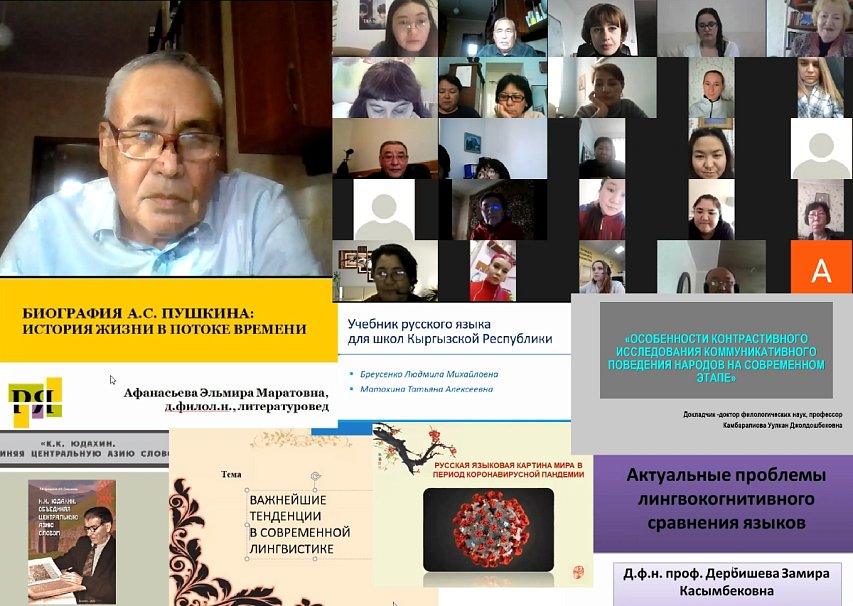
On December 19, 2020, at the Kyrgyz-Russian Slavic University named after the first President of the Russian Federation B.N. Yeltsin completed advanced training courses for teachers of philological disciplines at universities in the Kyrgyz Republic. The organizer was the Russian Language Institute KRSU. Leading experts in the field of philology and Russian linguodidactics from Russia and Belarus, as well as famous scientists from Kyrgyzstan who covered a wide range of problems of modern science, were invited as lecturers.
Over the course of two months, course participants became acquainted with new scientific directions and methodological developments, deepening their knowledge and adopting the experience of outstanding scientists.
The educational cycle was opened by the director of the Russian Language Institute KRSU, Professor M.J. Tagaev lecture on the description of the Russian language as a non-native language in the light of anthropocentric linguistics. Professor of the Russian State Humanitarian University G.E. introduced the main provisions of non-verbal semiotics to course participants. Kreidlin (Moscow).
A whole series of lectures was devoted to various issues of cognitive linguistics. They were revealed in detail in lectures by Vitebsk State University professor V.A. Maslova (Belarus), professor of the department of general linguistics and stylistics of Voronezh State University I.A. Sternin, professor of the Kyrgyz-Turkish University «Manas» Z.K. Derbisheva (Bishkek), Dean of the Faculty of Russian Philology of Osh State University G.A. Madmarova (Osh), AUCA professor U.J. Kambaralieva, (Bishkek). Leading specialists from the Institute of Russian Language A.E. made scientific presentations. Ernisova and A.S. Moldomambetova.
Professor of the Department of General and Russian Linguistics at the Institute of Russian Language named after A.S. introduced course participants to such new directions in linguistics as linguoculturology and legal linguistics. Pushkina V.I. Karasik and professor, head of the laboratory of legal linguistics and document science at Kemerovo State University N.D. Golev.
Professor, head of the Department of Stylistics and Rhetoric at KemSU L.A. shared interesting observations about the functioning of the modern Russian language. Araeva (Kemerovo) and professor, head of the department of Russian language and intercultural communications of the Siberian Federal University I.V. Evseeva (Krasnoyarsk).
A lecture on the advantages of using gaming technologies in teaching Russian as a foreign language was given by Professor of Moscow Pedagogical State University V.D. Yanchenko. The seminar participants were introduced to the new generation Russian language textbooks for schools in Kyrgyzstan by their authors – Candidate of Pedagogical Sciences L.M. Breusenko and teacher of Russian language and literature T.A. Matokhina.
An important milestone in the history of Russian philological science – 130th anniversary of the birth of the author «Kyrgyz-Russian dictionary» K.K. Yudakhina was highlighted in her lecture by O.L., Deputy Director of the Russian Language Institute KRSU. Sumarokova, who noted the importance of the historical aspect in teaching the Russian language and training philological personnel.
Lectures by the head of Pushkin projects at the State Institute of Russian Language named after A.S. were devoted to issues of Pushkin studies. Pushkina E.M. Afanasyeva (Moscow), during which new conceptual approaches to the study of the work of the great Russian classic were presented.
The result of the distance courses, which included 21 webinars over 48 hours, pleased the participants, lecturers, and organizers – 80 teachers of Russian studies from universities in all regions of the Kyrgyz Republic improved their professional qualifications, noting that such events help maintain contact with the best scientific schools of the CIS in the field of Russian studies and touch on a wide range of issues, including in the field of related scientific disciplines – history, ethnography, ethnolinguistics, ethnopsychology. Along with words of gratitude, the course participants expressed their desire to meet at such scientific sites as often as possible.


