
Nothing found for your search.
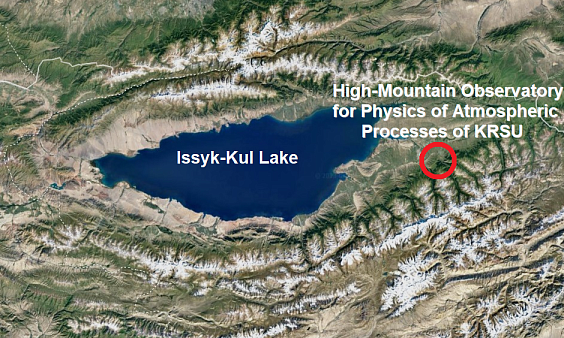
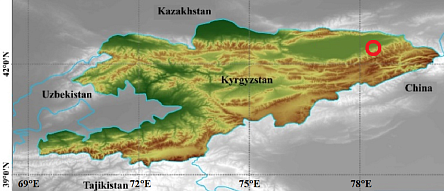
Location of the Field Experimental Base of the VGO FAP KRSU and the National Assembly of the Russian Academy of Sciences:
Field Experimental Base of the VGO FAP KRSU and NS RAS, located in the northeast of Kyrgyzstan in the Northern Tien Shan (42.46383 °N; 78.52895 °E; 1930 m above sea level), is a regional station (IAOCA-KRSU) that performs observations of atmospheric aerosol parameters using the photometer CIMEL within the framework of the AERONET/PHOTONS program.
AERONET (AErosol RObotic NETwork) Automated Terrestrial Atmospheric Monitoring Network — is the most important global aerosol monitoring network that has more than 700 ground-based solar photometers distributed throughout the world to provide high-precision, long-term and continuous observations of the optical, microphysical and radiation properties of the aerosol, performed with high time resolution and intended for various research purposes and are used in solving a wide range of scientific and applied problems.
The special geographical location of the IAOCA-KRSU station is determined by the significant influence of regional dust sources (Takla-Makan Desert), as well as the location of dust aerosol transport from more distant sources (North Africa, Middle East and Aral Sea).
The High-Mountain Observatory of the Physics of Atmospheric Processes KRSU and the National Assembly of the Russian Academy of Sciences conducts scientific research on important problems in the field of atmospheric physics, ecology, climate change, interaction of geospheres, geodynamics, seismology.
The key areas are
1. Experimental studies of the optical, microphysical and radiation characteristics of an atmospheric aerosol, based on the results of simulation, ground-based and satellite remote sensing:
2. Studies of the dynamic processes occurring in the various layers of the lower atmosphere and ionosphere in order to identify the pattern of the manifestation of atmospheric effects preceding earthquakes: