Expert «Skolkovo» Olga Nazaikinskaya: the transformation of universities requires a change in culture and thinking
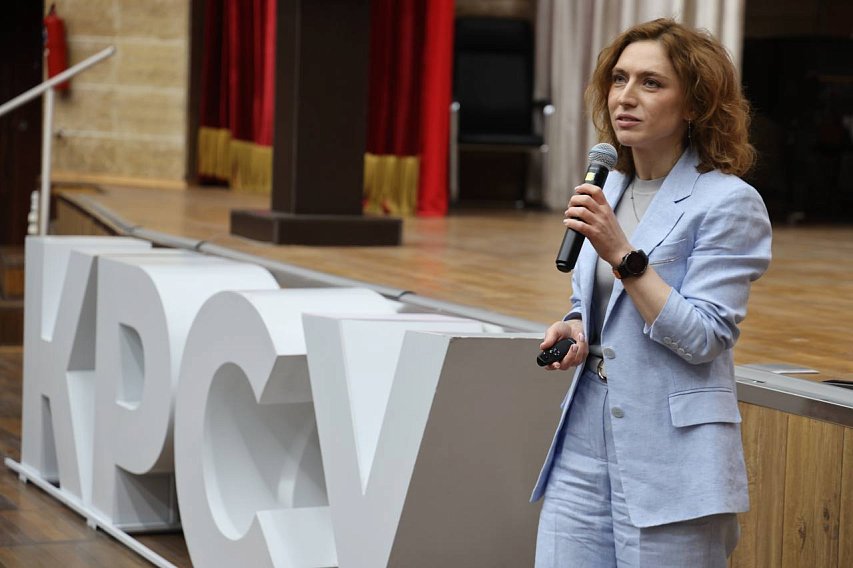
Olga Nazaikinskaya, director of the Center for Educational Transformation at the School of Management «Skolkovo», gave a lecture at the Kyrgyz-Russian Slavic University on modern approaches to university transformation. The speech took place as part of a working session and was aimed at the management team and academic community of the university.The expert emphasized that transformation is not just a set of reforms or organizational changes, but a deep process that affects the thinking, behavior and culture of all participants in the university environment.«Most importantly, transformation requires changing the perceptions, behaviors, and cultures of the people who work at and interact with the university. Without this, any structural changes will not yield results», noted Olga Nazaykinskaya.According to her, transformation is often mistakenly perceived as «a revolution» or a complete abandonment of the existing system. However, in reality we are talking about more complex and lengthy work.«Transformation is not destruction or creation from scratch. This is always working with heritage: a careful analysis of what already exists, abandoning what is ineffective, maintaining what is significant and gradually changing the system», the expert explained.Nazaikinskaya identified two key cases when the university really needs transformation. The first is a crisis associated with a sharp change in the requirements of the external environment, when the existing model ceases to meet new challenges. The second is the presence of a strong strategic ambition and vision for the future of the university.At the same time, she emphasized that transformation is a complex, long-term and resource-intensive process that must be approached consciously.During the lecture, special attention was paid to changing the role of the university in the modern world. According to the expert, today the university is a multicomponent system in which several basic processes coexist: education, science, innovation and, in some cases, its own professional practice.«The uniqueness of the university is that it unites several key processes that must develop simultaneously and be interconnected. It is at their intersection that new solutions are formed», Nazaikinskaya noted.At the same time, she pointed out one of the key problems: in many universities, only the educational function dominates, while other areas are much less developed, which limits development potential.A separate block of the speech was devoted to global trends in higher education. The expert noted the growing number of students in the world, increased competition for talented youth and the need for universities to adapt to new technological and economic conditions.«Today, countries compete for the best students because it is strong universities that shape the economy and quality of life», she emphasized.Among the key study programs changes, Nazaikinskaya highlighted the transition to product logic in education. We are talking about designing educational programs not from opportunities, but from request, taking into account the real needs of the market and future competencies.In addition, the individualization of educational trajectories becomes an important factor, allowing the formation of unique sets of competencies for each student and increasing his adaptability in a rapidly changing labor market.Separately, the expert focused on the influence of technology, including artificial intelligence, which is already beginning to change the educational process - from accompanying students to participating in teaching.At the end of the lecture, a discussion took place, during which university staff asked the expert questions regarding the practical implementation of transformation processes, the introduction of new educational models and interaction with external partners.Summing up, Olga Nazaikinskaya emphasized that universities cannot limit themselves to short-term planning.«A university is an organization that is obliged to think on the horizon of more than one year or even one cycle. We are talking about decades. Only in this case is conscious development and movement forward possible», she noted.The lecture became part of a comprehensive work to form a new model for the development of the university and allowed participants to take a fresh look at the tasks of managing changes in the higher education system.


