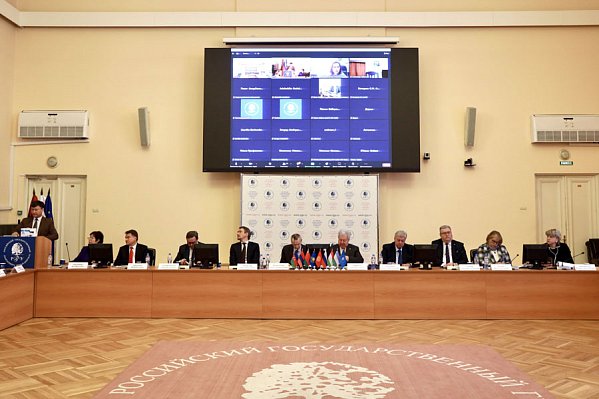
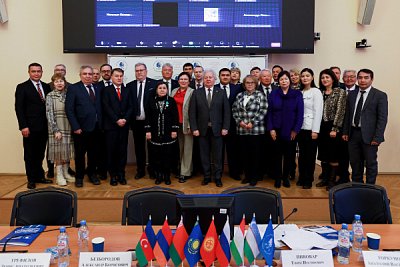
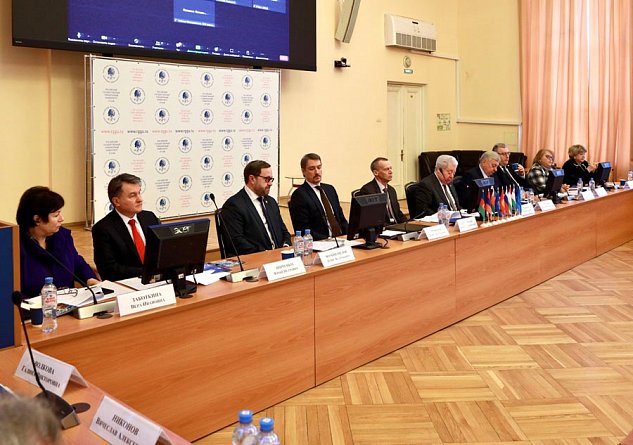
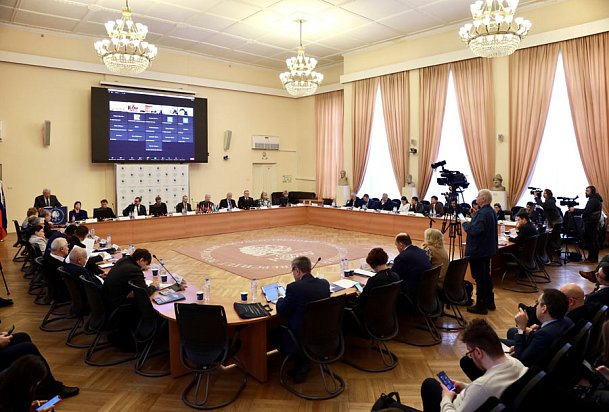
On January 18, an extended meeting of the Coordination Council of the Forum of Rectors of Humanitarian Universities and Deans of Humanities Faculties of Universities of the CIS Member States was held.
An extended meeting of the Coordination Council of the Forum of Rectors of Humanitarian Universities and Deans of Humanities Faculties of Universities of the CIS Member States was held in Moscow at the Russian State Humanitarian University.
Participants – heads of leading universities and faculties of the humanities from the Commonwealth countries – discussed current issues in the development of scientific and educational cooperation in the CIS.
CIS Secretary General Sergei Lebedev sent greetings to the meeting participants. The greeting says that over the years of its activity, the forum has become an authoritative international platform on which knowledge, ideas and best practices are exchanged between leading humanitarian universities of the CIS member states. The most important tasks of the forum closely echo the prospects for humanitarian cooperation defined by the concept of further development of the Commonwealth of Independent States.
- I express confidence that the Coordination Council of the Forum of Rectors of Humanitarian Universities and Deans of Humanities Faculties of Universities of the CIS Member States will discuss the issues raised in the format of a live dialogue and make decisions on further expanding ties between universities of the humanities of the CIS countries, which will undoubtedly contribute to the development and strengthening of the common humanitarian, educational and scientific space of the Commonwealth of Independent States, – noted by Sergey Lebedev.
Actingirector of the Kyrgyz-Russian Slavic University Denis Fomin-Nilov he made a report at the meeting about role and meaning humanitarian education and socio-humanitarian knowledge.
- The twentieth century was marked by the development of technology, nuclear energy and space exploration, and the emergence of digital technologies. However, in the 21st century it became clear that human capital is of utmost importance for stable development and improving the quality of life. It is socio-humanitarian knowledge and humanitarian education defines the face of humanity, shapes the culture of people, peoples and nations. The world of humanitarian ideas turned out to be like the world of viruses. Ideas spread among people very quickly. Moreover, some lead to the death of civilizations, while others lead to humanity reaching a new level of development," Denis Fomin-Nilov emphasized.
The Forum was organized by the Russian State Humanitariannew University, Moscow State Institute of International Relations, Scientific Council on Complex Problems of Contemporary History and Culture of Eurasia and the Russian Society of Historians and Archivists. The meeting was held with the support of the Ministry of Science and higher Education of Russia and the Russian World Foundation.


