Acting Rector of KRSU Sergey Volkov participates in the SPIEF session on a new model of higher education
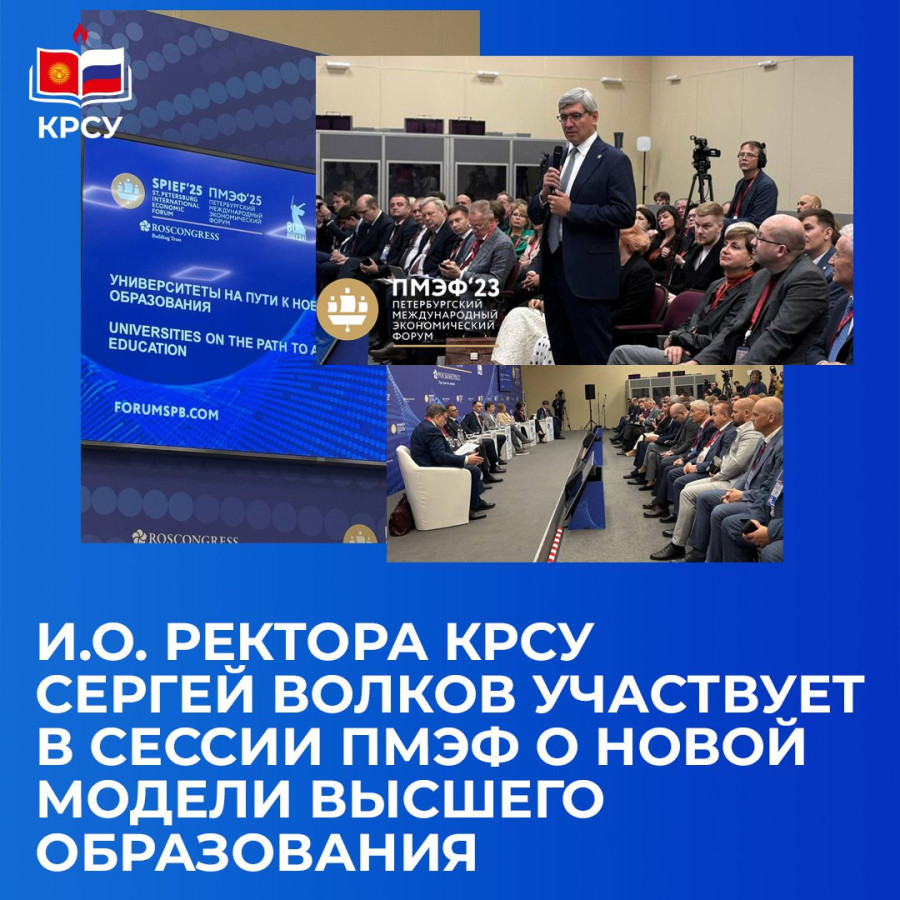
Acting Rector of the Kyrgyz-Russian Slavic University (KRSU) Sergei Volkov took part in the session «Universities on the path to a new model of higher education», held within the framework of the St. Petersburg International Economic Forum (SPIEF). The discussion on the transformation of the Russian higher education system was chaired by Deputy Minister of Science and Higher Education of the Russian Federation Dmitry Afanasyev.
The session was dedicated to the transition of Russian universities to a new model of higher education, which should be completed in the next two years. The issue of training personnel for the economy remains a cross-cutting theme of SPIEF, emphasizing the need for universities to adapt to modern challenges.
Deputy Minister Dmitry Afanasyev outlined the basic principles of the new higher education system. «Universities should focus on priority areas of economic development, but choose them consciously, based on their resources and competencies, and not following fashion trends», — he emphasized, citing as an example the unreasonable passion of some universities for hydrogen energy without an appropriate base.
Another important aspect, according to Afanasyev, is the integration of universities with industrial partners. Universities must build effective chains of interaction, offering not only technological solutions, but also business models that demonstrate their impact on the industry and the economy as a whole. «Working in business logic — this is what universities must learn», — noted the deputy minister.
Sergei Volkov’s participation in the session emphasizes the role of KRSU in the implementation of the new educational paradigm. The university is actively developing programs aimed at training specialists in demand in the economies of Kyrgyzstan and Russia, and is also strengthening international cooperation in the field of education.
The St. Petersburg International Economic Forum remains the leading platform for discussing global economic and social issues. The session on higher education brought together representatives of the academic community, government and business to jointly develop strategies for training the workforce of the future.