KRSU took part in the International Congress of Slavic Universities on youth policy and educational activities
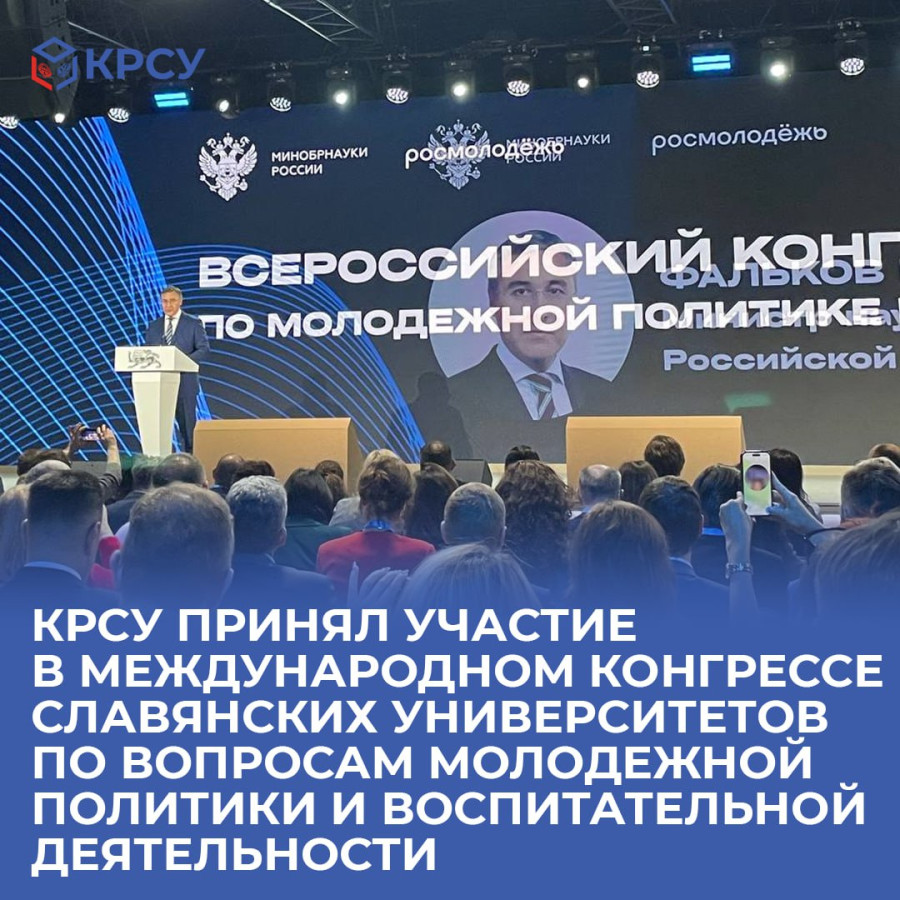
From December 16 to 18, the International Congress of Russian and National (Slavic) Universities was held in Moscow for the first time, dedicated to issues of youth policy and educational activities. The event was organized by the Ministry of Science and Higher Education of the Russian Federation together with MIREA – Russian Technological University.
The congress was attended by representatives of the leadership of the Kyrgyz-Russian Slavic University (KRSU), as well as delegations from the Belarusian-Russian University, Russian-Armenian (Slavic) University, Russian-Tajik (Slavic) University and partner Russian universities – St. Petersburg Polytechnic University Peter the Great and Siberian Federal University.
The event program included strategic sessions, training seminars and open dialogues with representatives of the Russian Ministry of Education and Science, during which the challenges and prospects for the development of youth policy and educational work in Slavic universities were discussed. Particular attention was paid to the introduction of new technologies into the educational process and expanding students' opportunities for professional and personal self-realization.
During the Congress, representatives of KRSU shared their experience of systematic work with the presidential platform «Russia – country of opportunity». As noted by the head of the Platform Assessment and Methodology Department, Alexandra Vaza, the Competence Center opened at KRSU was an important step in the development of «flexible skills» students and teachers. The center actively cooperates with the Polytechnic University of St. Petersburg, which allows us to adopt the best practices in the field of employment of graduates and work with ambassadors.
Following the Congress, participants presented draft roadmaps for the development of youth policy in 2025–2026. Russian partners presented initiatives to create joint programs and events.
Slavic universities continue to play an important role in the development of youth policy in the international arena, helping to strengthen ties between the educational systems of different countries.