The International Youth Historical School is ending in Bishkek
The International Youth Historical School (IIS) is ending in the capital of the Kyrgyz Republic, Bishkek «General History as a resource for the joint development of Russia and countries – members of the Commonwealth of Independent States». We continue to talk about the most significant events of the school.
The third day of the project began with an excursion to the Archaeological Museum of the Kyrgyz-Russian Slavic University named after the first President of Russia B. Yeltsin. Students were introduced to the history of the museum-office, which is based on the Department of History and Cultural Studies of the Faculty of Humanities. The museum's collection consists of archaeological finds from the Krasnaya Rechka settlement in the Chui Valley and the basin of Lake Issyk-Kul. The children appreciated the rich numismatic collection of the museum, ancient religious monuments of various faiths, miraculously preserved household items and jewelry from the flooded settlement at the bottom of Issyk-Kul. In addition, participants were shown ancient books and manuscripts.
Student of the Faculty of Philology of the State Institute of Russian Language named after. A.S. Pushkin Daria Alekseeva shared her impressions of visiting the museum.
«Despite the fact that the museum itself is small, it has many interesting exhibits, some of which are several thousand years old. Vasily Ploskikh, a professional archaeologist and director of the cultural and historical museum complex KRSU, told us about the museum’s collection. We learned first-hand about the details of archaeological expeditions, the intricacies of searching for objects under water and the history of many finds. When Vasily was telling his story, you could see how passionate he was, such an attitude towards his work is truly inspiring. Archeology underwater – this is incredible!»
Teams of participants continued to develop their projects under the guidance of experienced mentors. According to the assignment, thematically they should correspond to the tracks in which students take part: «Memory», «Knowledge», «Connections» and «Culture». In a few days, teams will have to make presentations of their work.
The next day, at the Kyrgyz State Historical Museum, project participants got acquainted with the history of the Kyrgyz people. The museum's exhibition covers the period from ancient times to the present day and includes sections on archeology, religion, crafts and statehood.
The excursion participants listened to a lecture on the ritual ceremonies and military affairs of the Scythians and Huns, as well as on the establishment of the power of the Turkic Khaganates and other states on the territory of modern Kyrgyzstan. The children were also told about the route of the Great Silk Road and its impact on the development of the region. In addition, students learned about the traditional way of life of the Kyrgyz people, which is associated with nomadic cattle breeding, and its tribal structure, and saw traditional homes – yurts. An important part of the exhibition was the period of Soviet history of the republic, which helped the participants understand what underlies the modern statehood of Kyrgyzstan.
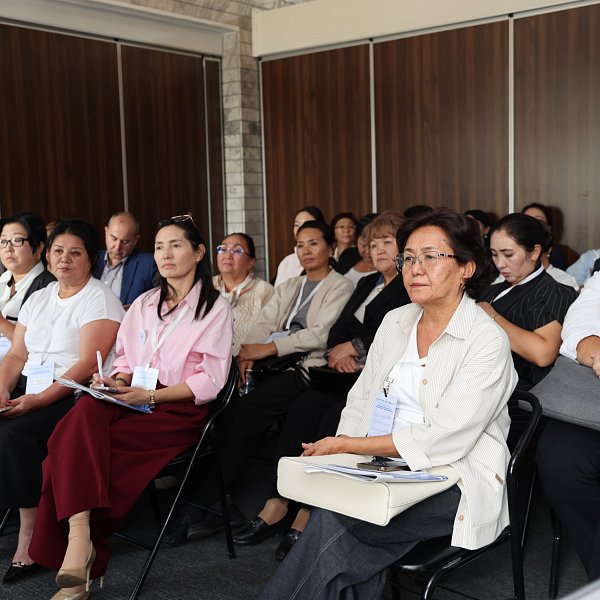
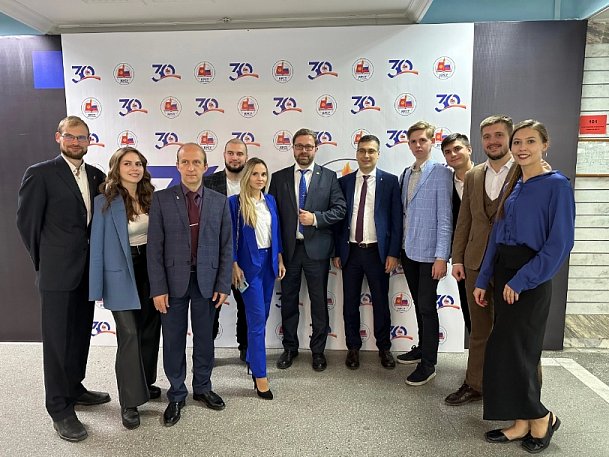
Next, the project participants and the delegation of the State Academic University of Humanities attended the ceremonial program dedicated to the 30th anniversary of the Kyrgyz-Russian Slavic University. Its events began with a panel discussion «The role of media in protecting historical truth», the speakers of which were prominent figures in science and higher education in Russia. As part of the discussion, Nikolai Promyslov, Vice-Rector for Science and Additional Education of the State Autonomous Institution of Science, took the floor:
«The way we perceive history is influenced by several areas of our lives: schools, higher education and media. Therefore, we must truly strive to ensure that information about the past presented in the media is reliable and based on true sources and scientific literature. We are faced with the task of searching or forming specialists who can convey complex matters to people in a light form.
There are many formats for this. Higher education institutions with the support of public authorities should be actively involved in solving these problems. It is necessary to encourage our historians to participate in media projects and directly connect them with the media. It is also possible to launch new programs in historical journalism and advanced training courses for professionals. This is – our common task, and it requires joint efforts on the part of universities and government agencies», – nikolai Promyslov expressed his opinion during the discussion.
As a continuation of the solemn program, a ceremony was held to sign cooperation agreements, at which the acting rector of the State Academic University of Humanities Ilya Sokolshchik and the acting rector of the Kyrgyz-Russian Slavic University Denis Fomin-Nilov entered into an Agreement between universities on the establishment of partnerships (cooperation) in educational and research fields.
«The State Academic University for the Humanities operates on the basis of institutes of the Russian Academy of Sciences, the potential of which we actively and successfully realize in the educational process. For our part, we offer cooperation to the Kyrgyz-Russian Slavic University through the creation of joint network programs for graduate and master's students. Interacting with such a large foreign partner is a new and completely unique experience for us, I hope it will be fruitful for all of us» – ilya Sokolshchik commented on the conclusion of the agreement.
The series of ceremonial events ended with a concert, during which representatives of Russian higher education congratulated the Kyrgyz-Russian Slavic University on its 30th anniversary.
Ilya Sokolshchik joined the wishes and expressed warm words on behalf of the GAUGN to the acting rector of KRSU Denis Fomin-Nilov.
«Since its founding, KRSU has been faced with the key tasks of its time – to promote the socio-economic development of the sovereign Kyrgyz Republic, to ensure advanced training of highly qualified personnel and to become a solid basis for scientific, educational, and broader – humanitarian ties with the Russian Federation and the countries of the Commonwealth of Independent States. I have no doubt that the new creative energy with which the Kyrgyz-Russian Slavic University enters the next decade will direct the accumulated competencies for the benefit of the common future of our fraternal peoples, and the University will act as a unifying bridge and increase its rich heritage.
I am confident that the further development of the University will contribute to strengthening warm and friendly relations between the Russian Federation and the Kyrgyz Republic, and our joint projects will achieve high results» – the acting rector of the State Autonomous Institution noted in his speech.
In honor of the solemn date, Ilya Sokolshchik also presented Denis Fomin-Nilov with a gift – a painting depicting ancient Russian and Kyrgyz heroes: Ilya Muromets and Manas. Both characters are the embodiment of strength, wisdom, courage and patriotism. Manas – hero of the Kyrgyz epic of the same name, who selflessly served his people and advocated for their unity. Ilya Muromets – one of the main characters of the ancient Russian epic. He was distinguished by remarkable strength and courage, fearlessly fighting the enemies of the Russian land.
Both heroes, who defended their peoples during the most difficult periods of history, are symbols of perseverance, fearlessness, a heightened sense of justice and selflessness. These features are also inherent in modern representatives of the Russian and Kyrgyz peoples. Therefore, the work of two great legendary heroes lives on and continues with their descendants. Russia and Kyrgyzstan jointly confront the difficulties of our time and continue to develop humanitarian ties and the scientific and educational space.