High interest in Russian education in the CIS: the experience of KRSU was presented at OBRFEST-2026
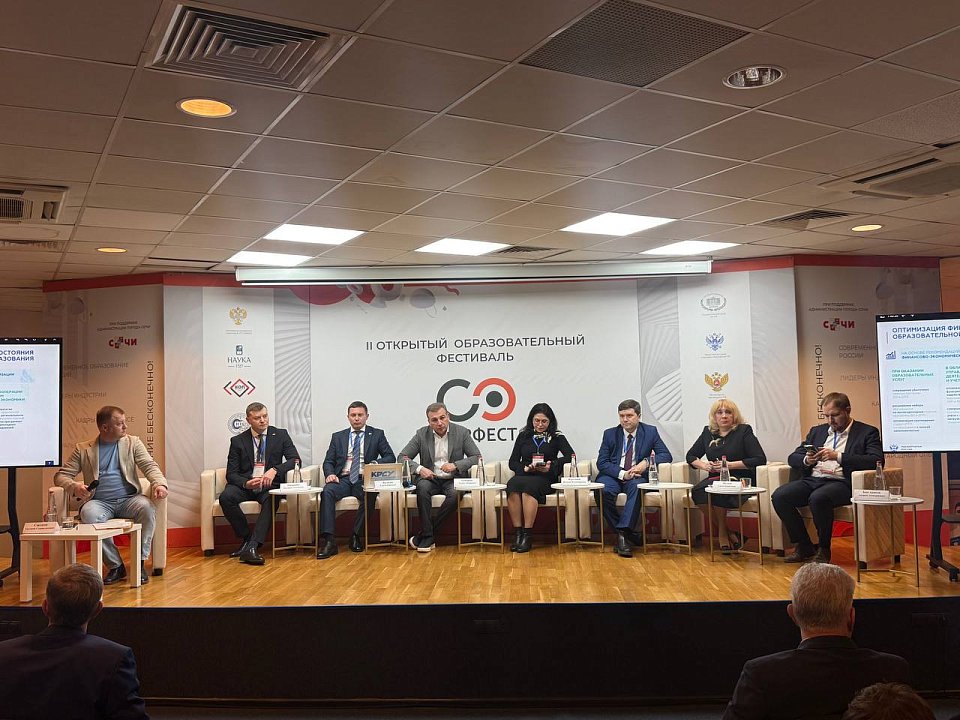
In Sochi, at the site of the Russian University of Transport (MIIT), the II Open Educational Festival OBRFEST is taking place — one of the largest events in the South of Russia in the field of education, bringing together about 3 thousand representatives of the academic community, authorities and the expert community.Opening the event, Deputy Minister of Science and Higher Education of the Russian Federation Olga Petrova outlined strategic guidelines for the development of the industry:«The aspects that are being discussed today — both the international perspective and personnel training — are fully consistent with the implementation of the decree on national goals, which defines key development guidelines until 2030 and in the future until 2036. We set up the education system to achieve technological leadership and develop competent, socially responsible professionals».Deputy Chairman of the State Duma Boris Chernyshov emphasized the need to move to practice-oriented solutions:«We need to build clear links between school, the secondary vocational education system, universities, science and the labor market. For now, we often remain at the level of concepts, while a specific calculation of resources and practical solutions is required. Universities today perform a key task — they train high-quality personnel who await the economy. Staffing shortages persist and need to be addressed now».During the discussion, Vice-President of the Russian Academy of Education Viktor Basyuk noted the key conditions for the successful development of the education system:«In my opinion, the success of development today depends not just on the set of study programs, but primarily on the coordinated actions of all participants in the process. Speaking about the semantic framework, I will highlight three areas: updating scientific research to meet the needs of the state, strengthening the value-semantic foundations of education and changing the function of the teacher».Vice President «Opora Rossii» Eduard Omarov focused on the need for close integration of education with the economy:«Universities are required to constantly change — in technology, content and content of education in order to respond to the demands of the time in a timely manner. Connection with business and the real sector of the economy —the key to successful training of specialists».A separate block was devoted to the development of engineering education. Director of the Phystech School Development Fund Andrei Bogdanov noted the growing interest of schoolchildren in technical areas and the need for systematic work of universities with pre-university training.Chairman of the Council of Rectors of the South of Russia, Rector of the Southern Federal University Marina Borovskaya spoke online, emphasizing the importance of digital services and artificial intelligence technologies in education.Director of the Department of Economic Policy of the Ministry of Education and Science of Russia Aslan Kanukoev outlined the key changes in the budget policy of the industry:«Today it is important not just to increase funding, but to build a transparent and effective system for distributing resources that will allow universities to develop sustainably and respond to the needs of the economy».According to him, the focus is — on moving to a more accurate model for calculating the costs of educational programs and eliminating the accumulated imbalances in the financing of individual study programs training. Particular attention is paid to supporting the secondary vocational education system, increasing the income of teachers and researchers, as well as expanding tools to support young professionals. Control over financial discipline is also being strengthened and mechanisms for assessing efficiency are being introduced.The forum is attended by the rector of the Kyrgyz-Russian Slavic University Sergei Volkov, who spoke at a plenary session dedicated to education development strategies.In his speech, he outlined the role of KRSU as an interstate university of Russia and Kyrgyzstan and a key platform for international educational interaction.«KRSU —this is actually “its” Russian university in Kyrgyzstan. If we talk about the international agenda and attracting foreign students, we act as a single window of opportunity», — noted Sergei Volkov.According to him, interest in Russian education in the CIS countries remains very high. «When we talk about the foreign agenda, you need to understand: there are four such interstate universities — Kyrgyz-Russian Slavic University, Belarusian-Russian University, Russian-Armenian University and Russian-Tajik (Slavic) University. And there is enormous interest in Russian education there», he emphasized.The rector also noted that the format of the interstate university allows us to simultaneously solve the problems of developing the educational space and training personnel.He emphasized the importance of the infrastructure development of the university:«Literally the day before, the agreement on the construction of a new campus was ratified by the Jogorku Kenesh. The project provides for the creation of a modern university environment designed for large-scale development of educational and scientific activities».Separately, he noted the humanitarian mission of the university:«The Russian language in Kyrgyzstan is enshrined constitutionally, and KRSU plays an important role in supporting and developing this space».Sergei Volkov added that the university demonstrates sustainable development dynamics:«Today the university is entering new trajectories of development. We are forming our own system for training applicants and subsequent training, and already now the number of students reaches about 10 thousand».The plenary discussion of OBRFEST-2026 is devoted to the development of effective strategies for the development of education in the context of modern challenges, including personnel training, integration of science and economics and transformation of the role of universities.


