Significant meeting of linguists in Uzbekistan
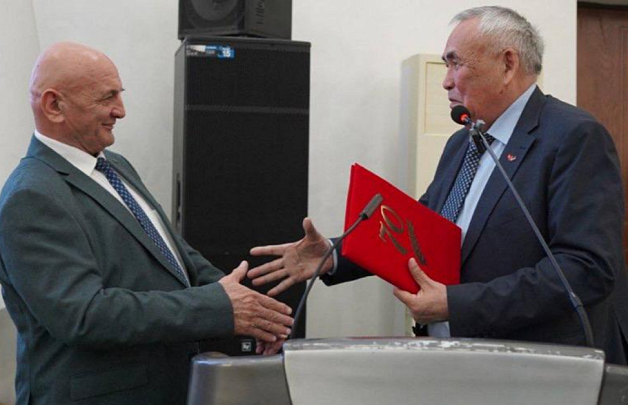
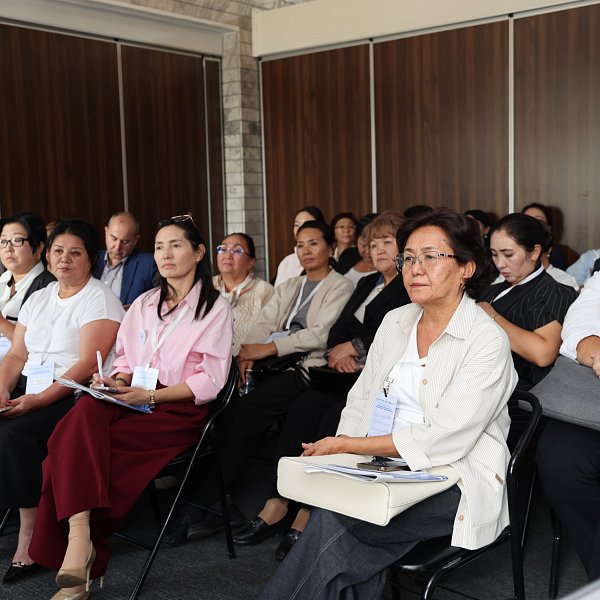
At the invitation of the rector of the Uzbek State University of World Languages (g. Tashkent) from March 11 to 14, 2026, Director of the Institute of Russian Language KRSU, Professor, Doctor of Philology Mamed Dzhakypovich Tagaev took part in the work and made a report at the Plenary session «Bilingualism and translinguism in the linguistic space of Kyrgyzstan: towards an integrative model of trilingual linguoculturology» at the International Scientific and Practical Conference «Current problems of Russian linguistics and comparative studies: traditions and innovations», dedicated to the 70th anniversary of the professor doctor of Philological Sciences Dusmamat Sattarovich Kulmamatov.As a representative of KRSU M.J. Tagaev conveyed a welcoming address to the hero of the day from the rector of our university – Sergei Yuryevich Volkov.D.S. Kulmamatov – well-known specialist in the field of philology and historical linguistics. His range of scientific interests is related to the study of historical documents and translation practices of the 17th century, in particular to the linguistic analysis of ancient Russian translations of labels (written decrees) of the Khiva and Bukhara khans, their petition ambassadors, charters of Russian tsars, etc.Representatives of the scientific community from Moscow took part in honoring the outstanding Uzbek scientist and in the conference dedicated to his anniversary: T.V. Kortava, Vice-Rector of Moscow State University. M.V. Lomonosov, Doctor of Philology, Professor, Academician of the Russian Academy of Education, Vice-President of MAPRYAL; M.I. Chernysheva, leading researcher at the Institute of Russian Language named after. V.V. Vinogradova, Doctor of Philology, Professor, Chairman of the Commission on Lexicology and Lexicography at the International Committee of Slavists; V.N. Mushava, Doctor of Philology, Professor of Kalmyk State University (g. Elista, Russia).Scientists from Kyrgyzstan, Kazakhstan, Tajikistan and Uzbekistan were widely represented, in particular from scientific centers in Tashkent, Samarkand, Bukhara, Termez, Namangan, etc.In his report, Professor T.V. Cortava spoke about the enormous contribution of Professor D.S. Kulmamatov, representative of the Moscow Linguistic School, student of the outstanding Turkologist I.G. Dobrodomov, in historical comparative studies in terms of linguistic analysis of documents of the 17th century, testifying to diplomatic ties between Russia and Central Asia.Professor M.I. Chernysheva touched upon the issue of current areas of modern lexicography, covered in detail the issue of non-alphabetic dictionaries, highlighting such types as ideographic, conceptual, linguoculturological, axiological, etc.In the report of Professor V.N. Mushaev presented the results of research into the relationships between the Mongolian and Turkic languages, which were reflected in a series of publications on this issue. It is important to note that the object of research was also the linguistic characteristics of the residents of Kyrgyzstan of Kalmyk origin. The team of authors of this monograph included scientists from Issyk-Kul University. K. Tynystanova – Professor S.N. Abdullaev and associate professor U.K. Kadyrkulova.Interest was aroused by the report of Professor M. Dzhusupov, a famous linguist, who addressed the problem of functional styles in the relative texts of the Russian and Kazakh languages, highlighting in them universal and nationally specific features that are revealed during the translation process.M.J. Tagaev, professor at KRSU, made a report at the Plenary session, where he announced the emergence of a new linguistic direction – of translingual linguoculturology and noted the process of a smooth transition from bilingualism to translinguism, and translinguality is understood as the mental state and norm of speech behavior of a linguistic personality of the 21st century. The breakout sessions also featured reports from representatives of Kyrgyzstan – G.S. Tagaeva and E.T. Koesheva from KSU named after. AND. Arabaeva.In total, over 90 reports of scientific, theoretical and scientific-methodological content were heard at the Plenary and sectional sessions of the International Conference, which concerned theoretical problems of modern linguistics, interaction of languages, the functioning of the Russian language in the countries of Central Asia and scientific and methodological issues of language teaching.The speeches of scientists from Tajikistan, Kazakhstan, Russia were meaningful and interesting, and, of course, there were many speakers from various regions of Uzbekistan. The initiator and organizer of this event in Tashkent was the Uzbek State University of World Languages.The materials of the reports and speeches were collected in articles in a collection published at the beginning of this international scientific meeting, and covered a wide range of topics, questions and problems: aspects of comparative history, comparative, typological linguistics, as well as comparativistic direction.Speech by M.J. Tagaev, where the problems of bilingualism and translinguism in the modern linguistic space were deeply analyzed in their projection onto the integrative model of translingual linguoculturology, became resonant. The report organically integrated into the general theme of the conference, and was received with great interest and excitement by the scientific community. It is also important to note that the participants in this meeting sought to establish personal contacts and scientific cooperation relations with a scientist from Kyrgyzstan.