.jpg)
.jpg)
.jpg)
Early in the morning of May 19, from the main building of KRSU named after. B. Yeltsin, a solid column of executive buses with police escort departed, outside the windows of which one could see dozens of young, joyfully lively faces.
Leaving behind the university building with the bronze Alexander Sergeevich standing in front of it, the auto-cavalcade headed for the southern part of the capital and further, towards Besh-Kungey.
It might seem to the townspeople watching this that the student youth decided to go out to a fun country party. And, I must admit, they would be half right. For after just half an hour of driving, the buses, turning right from the main highway, stopped in a glorious corner of nature, known to the KRSU team as TsONIK – Center for Education, Science and Culture of the Kyrgyz-Russian Slavic University.
Once upon a time there was a military hospital of the Soviet Army, then – of the Russian border troops in Kyrgyzstan, and after the latter left, this social complex was transferred to the university, becoming a favorite venue for useful cultural and educational events here.
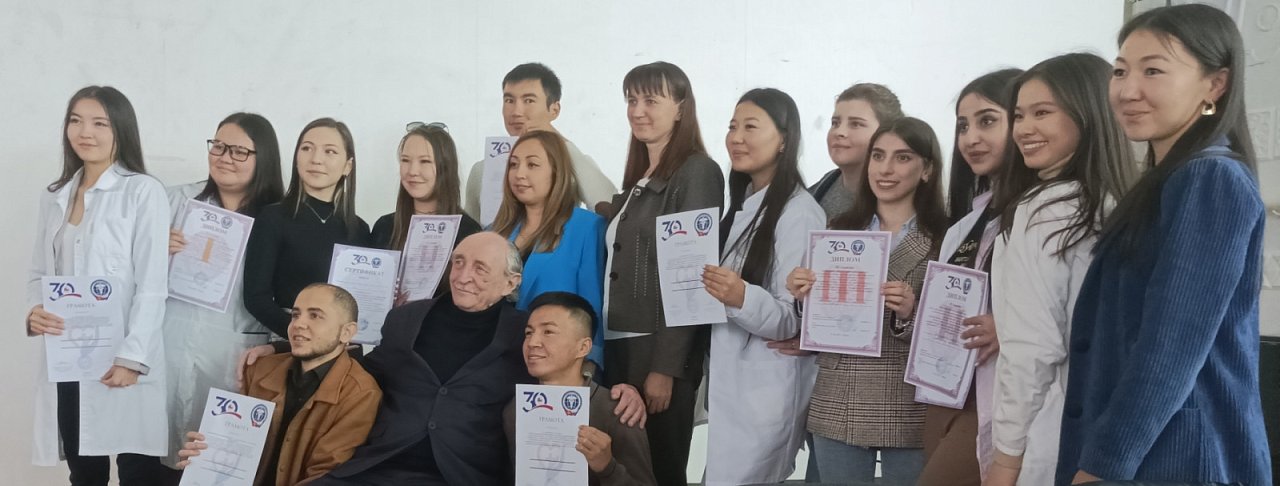
This time, traditionally in May, students and employees of the Faculty of Medicine of KRSU arrived here to hold the XXII annual final scientific and practical conference «Youth scientific creativity – an effective way to train medical and biological personnel», dedicated to the 30th anniversary of their native university.
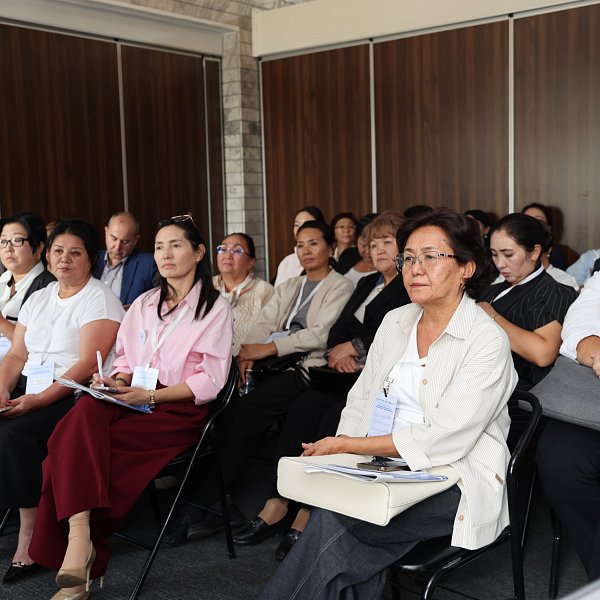
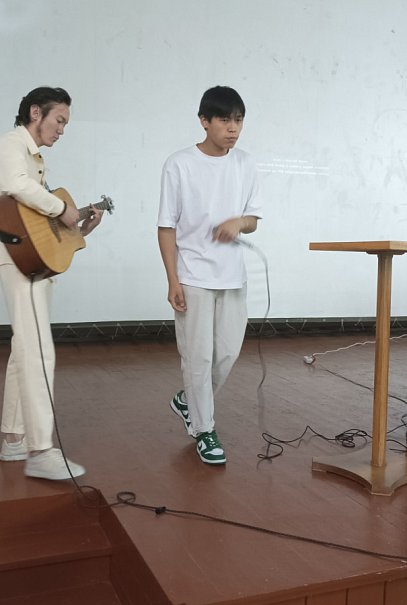
It opened at 9.00 am in front of a crowded hall of the Center for Information Research (after all, more than 200 people came here) with a plenary session, the sign to which was submitted by the Vice-Rector for Strategic Development of the Medical Department, Professor A. Zarifyan, and the new dean of the medical department, Associate Professor R. Karaeva. However, even before their welcoming words, the gathered audience was warmed up and inspired by the student duo of Saldarbek Diaz and Anastasia Tankova with their songs.
After which reports were heard. As always, the first of them related to the history of Russian medicine and were dedicated to our famous luminaries – the prominent historian of medicine, Associate Professor Kashar Abdulin, who, if he had not passed on to another world, would have turned 90 these days, and the now living Associate Professor of the Department of Pharmacology of KSMA Turdaly Maamatov – on his 80th birthday.
But the main highlight «of the plenary» was the report on the comparison of forensic systems in the Kyrgyz Republic, Russia and the Republic of Korea, brilliantly voiced in Russian by a 5th year student of the specialty «dentistry» KRSU, a citizen of South Korea Bang Sang Hwan.
After the plenary session, the participants dispersed into 10 sections, two of which, due to the large number of reports, had to be divided into subsections. A new phenomenon, compared to past conferences, was the separation of the biomedicine section, represented by messages from KSMA and KTU students. This very fact speaks of the seriousness of the intention of the rectorates of these two leading universities in the country to open a joint faculty with a biomedical focus! In general, one can only be glad that not only «Slavs», but also representatives of KSMA, MSHM MUK and other universities took part in the conference.
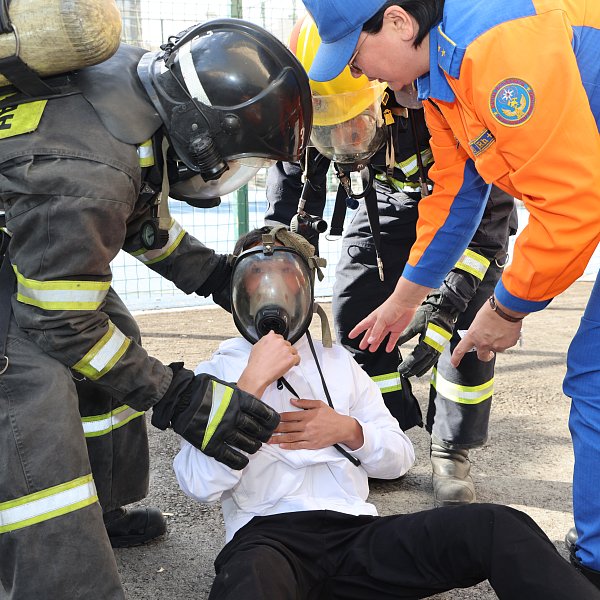
In total, in the sections of extreme medicine and morphology, internal and infectious diseases, surgery, traumatology and oncology, neurosciences, obstetrics, gynecology and pediatrics, public health and healthcare, hygiene and adaptation of students to the educational process (1), public health and healthcare, hygiene and adaptation of students to the educational process (2), dentistry, beginning researchers (1), beginning researchers (2), as well as biomedicine, 213 reports by 426 authors were presented. They were assessed by 10 juries, which included leading teachers and scientists KRSU, KSMA and MSHM MUK.
And in order not to miss or offend any young talent, the organizing committee provided not only diplomas of three degrees, but also special certificates in the following categories: «For successful scientific debut», «For relevance of scientific research», «For high scientific and organizational abilities», «For oratory skills», «For the ability to conduct a discussion», etc.
The first results of the sections' work began to emerge around 4 p.m. A total of 27 first-class diplomas, 38 – second and 37 – third, were awarded to the best speakers. And there are – 64 nomination certificates. Moreover, authors from other universities have won high places more than once.
Only at the beginning of the sixth was it possible to begin the procedure for reporting section chairmen and awarding the best. But the audience's interest has not dried up. As a result, almost all awards found their heroines and heroes. It was nice to watch the joyful emotions of the winners, especially when it concerned students from Syria, Jordan, India, Pakistan, who immediately reported their successes home on their mobile phones.
Neither the periodic rain nor the sudden blackouts, which the staff of the Center for Scientific Research, led by its energetic director Marat Chymyrbaev, heroically dealt with, overshadowed the mood of the scientists.
Many thanks to him and his team, the traffic police management and the police officers who ensured the delivery of the participants, the employees of the KRSU printing house and Vasily Rudov, who produced certificates and diplomas in a timely manner. Our collective gratitude – to the rector of the university, academician Vladimir Nifadiev, for his constant support of the faculty’s initiatives! But special «chon rakhmat!» intended for students, their supervisors, jury members and the dean's team led by the resilient Chinara Nagoybaeva.