«Rhythm of Eurasia». Interview with Vladimir Nifadiev
For Russia and Kyrgyzstan, 2020 is a special year –both states will celebrate the 75th anniversary of Victory in the Great Patriotic War of 1941 in close unity– 1945, and will also hold a cross Year, which will affect all areas of their interaction and strategic partnership. One of the main topics on the agenda of the planned events will be scientific and educational cooperation. «Rhythm of Eurasia» considered that the best example of its implementation is the practice of a quarter-century of functioning in the Kyrgyz-Russian Slavic University (KRSU) in the Kyrgyz Republic.
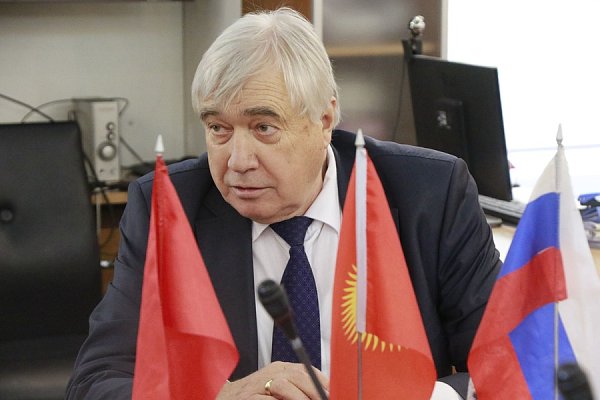
Rector of KRSU, Academician of the National Academy of Sciences of the Kyrgyz Republic Vladimir Nifadiev told a correspondent «RE» about what a significant year means for the university he heads.
– Vladimir Ivanovich, an important event occurred a few days ago – Rosobrnadzor recognized the Slavic University as having passed state accreditation of educational activities for a period of 6 years. In fact, the university passed an important exam and confirmed its right to educational activities, which once again demonstrated its significance for Russia. It turns out that the cross Year of two states – is the year KRSU?
–I believe that the accreditation examination carried out by Rosobrnadzor became a kind of combat review of the readiness of the university staff for transformations in educational and scientific activities. They are ripe and they are coming. Therefore, accreditation became a good reason to rethink what has been done and develop a new strategy for the life of the university, which is a unique educational institution due to the fact that it is – the brainchild of Russia and Kyrgyzstan. When implementing educational programs of higher education, programs of secondary vocational education, basic and additional general education programs, additional vocational programs, basic vocational training programs, the university is guided by the legislation of the Russian Federation and the Kyrgyz Republic regulating the implementation of these educational programs. This situation ensures the integration of the university into a single educational space of the CIS countries and non-CIS countries.
Since September 2011, the university has made a transition to a level system for training bachelors, masters, and specialists. We implement more than two dozen enlarged groups of study programs and specialties at all levels of higher education: bachelor's, master's, specialty, postgraduate and residency. The university, where more than 9 thousand people study, has 7 faculties and 92 departments. The educational process is provided by more than one thousand people from among the teaching staff, of which 70% have an academic degree of candidate or doctor of science.
The university trains doctors and lawyers, mining and mechanical engineering specialists, economists and historians. The list does not end with these specialties. In addition, the university has a college and a secondary school that organize the educational process according to Russian educational standards with a national component.
That is, today the university is a classical educational institution of higher education, in the sense that it implements classical higher education programs at all levels, forms interdisciplinary educational programs, carries out fundamental and applied scientific research, and designs individual educational trajectories.
In addition, I would like to note that an important area of our activity – is cultural and educational work and the education of an active social civic position among students. This is very important for our university, since one of its tasks is to promote the preservation, development and mutual enrichment of the culture, languages, historical and national traditions of the peoples of the states that founded it, that is, Russia and Kyrgyzstan. The training of specialists for various fields of human activity, coupled with their development of social activity aimed at strengthening friendship and cooperation between two strategic partners, indicates the importance of the mission assigned to the university. However, specialists of this quality will be in demand not only in Russia and Kyrgyzstan, but also in other EAEU countries.
–In the context of global modernization, the fate of any state is determined by the state and prospects for the development of its scientific resources. What role does the University of Russia and Kyrgyzstan play in strengthening ties between the scientific world of the two countries?
–In Soviet times, when the science of Kyrgyzstan was an integral part of the scientific complex of the USSR, the scientific developments of Kyrgyz scientists were of state and international importance. Suffice it to recall the development of a soil intake device used to collect lunar soil during spacecraft flights to the Moon. Today, in conditions when the process of global economic, political, cultural and religious integration and unification is expanding in the world, the science of Kyrgyzstan in the interests of sustainable development of the state and increasing its efficiency cannot escape the issues of international scientific and technical cooperation and international integration in the field of research and technological development. This is all the more relevant in the context of the fact that the near future of humanity is connected with automation, robotics, digital technologies, solving environmental, social and human health problems.
I note that many of the mentioned problems have long been in the field of view of university scientists. In the current conditions, KRSU specialists are interacting with the consortium «Digital Economy», which aims to create conditions for ensuring digital transformation and spatial development of the regions of the EAEU countries.
The high-mountain observatory of the dynamics of atmospheric processes KRSU, NPO «Typhoon», in collaboration with the Space Research Institute of the Russian Academy of Sciences, are working productively on the problem of assessing nano- and microscale aerosol particles for regional climatic variability, creating for these purposes a special device that allows measuring the mass concentration of the aerosol.
Our scientists are working on projects for the economic development of Kyrgyzstan. The problem that KRSU economists are solving is as follows: «Adaptation of developed economic forms to the economy of the Kyrgyz Republic». It is thanks to scientific achievements in this area that the university became a national developer from the Kyrgyz Republic of the Interstate Program for Innovative Cooperation of the CIS Member States for the period until 2020.
Serious progress has been made in medicine. For developments in the treatment of various types of dermatoses, university scientists were awarded the Gold Medal of the World Intellectual Property Organization.
In its activities, the university strives to solve the problem of forming a closed system «science – education – production». Thus, in the mining quarries of Russia and Central Asian countries, the Blast Maker software and hardware complex and the automated system for the design and production of drilling and blasting operations in quarries (SAMR BVR) are effectively used. Another achievement – introduction of a set of methods for instrumental monitoring of the stability of hydroelectric dams under seismic and man-made influences. By the way, seven university employees became laureates of the State Prize of Kyrgyzstan for their contribution to the development of science and technology.
It would be difficult to develop in solving scientific and educational problems without establishing comprehensive connections with various educational, scientific and cultural institutions of countries near and far abroad. KRSU has concluded approximately 380 agreements with universities in the CIS countries, Europe, and Asia. The main partners are Russian universities and scientific institutions.
All this is being done for the benefit and in the name of the growth of the main person of the university – the student, who in the near future will bear the burden of responsibility for the development of his state, be it Kyrgyzstan, Russia or another country. Therefore, the issue of creating a creative environment, providing conditions for including our students in scientific research and connecting them to entrepreneurial activity has always been relevant at the university.
Last year, students of the Faculty of Economics of KRSU Maxim Sutsepin and Farhad Delsuz, participating in an international competition «100 ideas», successfully presented the Grow up project, aimed at improving the standard of living of farmers and developing agriculture. And before that, the guys’ work was recognized as the best IT project in Kyrgyzstan.
My deep conviction: young people must feel involved in the ongoing processes, participate in them, and contribute to their development. Young people have such qualities as sociability and a craving for new things. They must be used. In 2019, medical students stood on the winning podium 58 times at international and national Olympiads and competitions. It was gratifying that the guys were on par with their Russian, Uzbek, and Kazakh peers, which gave them the opportunity to strengthen ties and become friends.
In short, the whole focus is on young people charged with creation. Moreover, she has wonderful mentors and excellent examples in the past.
– The main thing is that young people do not lose their life guidelines and determine the right priorities. It is no secret that the past you spoke about is now under fire from history redrawers. We have reached the point of denying the merits of the Soviet people in the victory over fascism. Under threat – implementation of integration projects in the post-Soviet space. What is your recipe for preserving historical memory? How are students developing an active social and civic position within the walls of your university?
– There really is a problem. Our students and teachers are not isolated from society and, naturally, are in the field of information influence of various kinds of falsifiers of history. The emphasis is on the historical illiteracy of some young people, on the loss of the cult of the victorious hero in individual families, on the prevalence in the minds of young ideas of the Internet as the main source of knowledge, as opposed to the same popular science literature, the lack of which is obvious, on the ineffective and unadapted in accordance with challenges information and propaganda mechanism for protecting our historical heritage. Such a legacy, without any doubt, is the Great Victory, which is inseparable from other important events in Russian history. For example, for Kyrgyzstan one of them is the Great October Revolution. University scientists talk about these events in the language of documents, inviting readers to draw their own conclusions and conclusions. Books published by the university from this perspective resonate with numerous readers.
We are looking for heroes. Trying to fill the shortage of idols, we tell students about people who left a noticeable mark on the history of Russia and Kyrgyzstan. A book series «Eurasians – creators» is offered to help everyone who is looking for life guidelines. Chingiz Aitmatov and Nikolai Mikhailovich Przhevalsky will talk from the pages of books published by the university about the importance of creative activity, the importance of a scientific approach in studying various problems, and about Russia’s actions in Central Asia.
During the celebration of the 75th anniversary of the victory, our students will receive a monograph «Front Roads of People's Deputies» as a gift, dedicated to the feat of deputies of the Supreme Council of the Kyrgyz SSR of the first convocation on the fronts of the Great Patriotic War. This book is based on the results of the university's search work. We are not just looking for soldiers lost on front-line roads and in time, we are also immortalizing them in book publications. Before this, the collection «Stalingrad Diary of Kyrgyzstan» was published. It resurrects more than 50 forgotten names.
All events held at the university in honor of this significant date are of a practical nature that will allow our students to feel their involvement in the military exploits of the generation of winners. For example, KRSU students were the first in the republic to join the patriotic movement «Victory Volunteers» and have already held a number of actions. During the interuniversity student video film competition «Credit» announced by the university, dedicated to the anniversary of the Victory and the cross Year of Russia and Kyrgyzstan, we hope to see and appreciate the view of the modern generation on the Great Patriotic War. I am sure that our guys will support their great ancestors.
– Another topic of concern concerns the role of the Russian language in Central Asia. Is it known that Russian President Vladimir Putin expressed gratitude to the university staff for strengthening the position of the Russian language in Kyrgyzstan? What should you do to preserve the good name of the great and mighty and his importance in the region?
– The Russian language for Central Asia has been the language of creation since Russia came here. We recently celebrated at the university the 100th anniversary of the birth of Turdakun Usubaliev, who led Soviet Kyrgyzstan in the 60-80s of the last century. This was a noticeable period of rise in Kyrgyz science, economics, and culture. Society was charged not only with military, but also with labor exploits – hydroelectric power stations were built, scientific and cultural facilities were built, new enterprises were opened, and housing construction was carried out. Thousands of people from different regions of the Soviet Union worked on construction sites in Kyrgyzstan.
In this whole process, the link was the Russian language, which at the same time provided an opportunity for the development of the Kyrgyz language. In 1967, the author of the first in the history of the republic «Kyrgyz-Russian dictionary» Konstantin Kuzmich Yudakhin – a Russian man born in the Russian city of Orsk, became a laureate of the USSR State Prize. In May, the university will host events to mark the 130th anniversary of this great scientist who united Central Asia in words. One of them will be the opening of the Russian Language Institute.
We set the goal of turning KRSU into a basic organization for promoting the Russian language and preserving Russian culture in Kyrgyzstan and Central Asia as one of the important conditions for the development of interethnic and intercultural dialogue.
Valentin Moskvin,
«Rhythm of Eurasia»