IRA KRSU AND IRA RUDN: JOINT LESSON IN PEDAGOGY AND LINGUOCULTURE
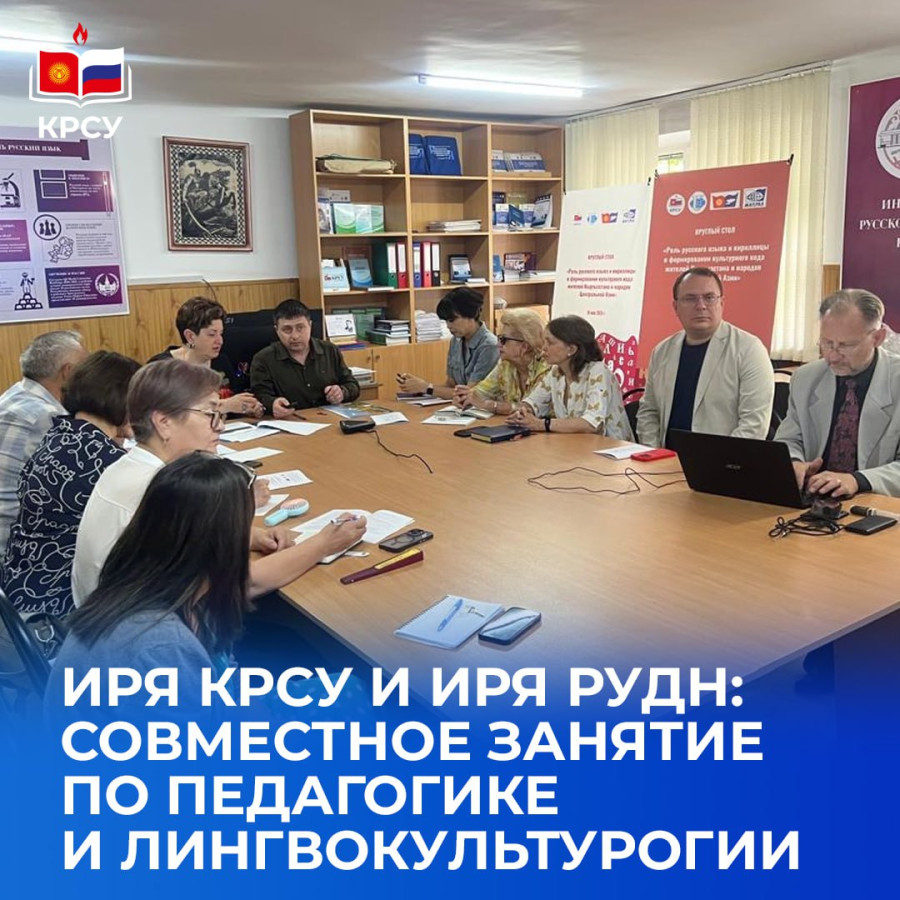
The first lecture at the Institute of Russian Language named after May 15 was dedicated to linguocultural science as one of the young, promising and developing study programs linguistics. A. O. Orusbaeva KRSU regular scientific and methodological seminar for Russian scholars. The session was held in a mixed, online and offline format. Dmitry Sknarev – lecturer, guest from Moscow, employee of the Peoples' Friendship University of Russia (RUDN) named after. P. Lumumba, Associate Professor of the Department of Russian Language and Literature, Doctor of Philology, Professor – made a report «Development of linguoculturology in Russia and Kyrgyzstan at the present stage: points of interaction».
Having informed the audience about the success of the speeches of representatives of KRSU, members of the delegation of Kyrgyz linguoculturologists at III At the International Linguocultural and Cultural Forum, which took place last fall in Moscow, the scientist noted the growing interest of the Russian scientific community in Kyrgyz research in this area. «Articles and speeches by Kyrgyz linguists – professors Mamed Dzhakypovich Tagaev, Pamira Kadyrbekovna Kadyrbekova and a number of other researchers make a great contribution to the development of this section of linguistics», – emphasized Dmitry Sknarev, noting in particular the success of the monograph «Key concepts of Kyrgyz linguistic culture» by the Kyrgyz linguist, Doctor of Philology, Professor Zamira Kasymbekovna Derbisheva. He further quoted a statement by a colleague from RUDN University, professor, doctor of philological sciences Vladimir Vasilyevich Vorobyov, that linguoculturology, as a rapidly developing branch of knowledge, is «a zone of turbulence», giving rise to bold hypotheses in science.
The speaker also focused the attention of the seminar participants on linguistic and cultural studies of the influence of advertising and the Internet on the modern Russian language, as well as on the formation of a linguistic personality in the virtual space.
The second lecture was devoted to the procedure for entrance exams to universities. A representative of RUDN University, senior lecturer at the Department of Russian Language and Linguoculturology at the Institute of Russian Language of this university, Candidate of Pedagogical Sciences Ekaterina Kulikova made a report «New format for entrance tests in the Russian language to universities of the Russian Federation». She noted that applicants from Kyrgyzstan are distinguished by their competent Russian speech compared to representatives of a number of other post-Soviet countries of Central Asia. «Guys from Kyrgyzstan come with a different knowledge of the Russian language, – the lecturer continued and added, –only young people from Kazakhstan can compare with them in this matter». Demonstrating a number of tests for entrance exams, the speaker drew the attention of the lesson participants to the fact that the final question should reveal how competently and reasonably the applicant can reflect in Russian.
He gave a general word about the anthropocentric paradigm in the theory and practice of teaching students the Russian language director of the Institute of Russian Language named after. A. O. Orusbaeva KRSU, Doctor of Philology, Professor Mamed Dzhakypovich Tagaev. He introduced listeners to the features of the anthropocentric model and linguistic-cultural code – an effective tool for creating and understanding national-cultural images of Russian paremias, representing archetypes of national-cultural originality of languages. According to the scientist, this approach, taking into account the human factor and historical and cultural uniqueness, contributes to the understanding of Russian speech as a repository of the linguistic and cultural code of Russian culture.
After the lectures there was a discussion. In online and offline formats, participants asked questions. A lively debate was caused by theses about the influence of advertising and the Internet on the figurative structure of the Russian language, new approaches to testing to determine the level of proficiency in speech culture, as well as an anthropocentric approach to teaching students.
Regular educational and methodological seminars with the participation of students, university teachers, researchers and those who show interest in linguistics and linguoculturology have become a good tradition of the Institute of Russian Language KRSU.


