«Kyrgyz-Russian dictionary» Yudakhina: when words do not diverge from deeds
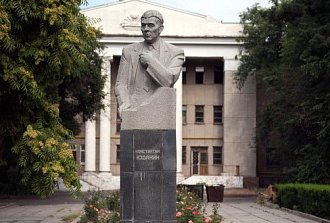
Olga Sumarokova, «Rhythm of Eurasia». The cross year of 2020 between Russia and Kyrgyzstan symbolically coincided with many memorable dates that deprive skeptics of any opportunity to refute the immutable truth – The 165-year union of the peoples of the two states, despite the greatest trials of history, has always been charged with the creative energy of friendship and cooperation. And it is personified by outstanding Eurasians, among whom the great Russian Kyrgyz Konstantin Kuzmich Yudakhin (1890-1975) – author of the legendary «Kyrgyz-Russian dictionary», the first edition of which celebrates its 80th anniversary this year.
In 1927, the USSR launched a project to process and supplement the multi-volume work of the Russian orientalist-Turkologist, ethnographer and archaeologist V.V. Radlova «Experience of a Dictionary of Turkic Dialects» (1888–1911), which was a rich collection of vocabulary and phraseology of numerous living and ancient Turkic languages. According to the project drawn up by members of the commission, headed by Academician S.F. Oldenburg, in the new edition of the dictionary it was planned to change the transcription of words taken from the poem by Yusuf Balasaguni «Kutadgu bilig», include an additional number of quotes and add new lexical material to this fundamental work. Konstantin Yudakhin, a teacher at the Leningrad Oriental Institute, who graduated from the Central Asian State University (SASU) in Tashkent two years earlier, was entrusted with expanding the section containing the vocabulary of the Kyrgyz language.
The high trust placed in the young scientist was explained by the serious contribution that he had already made to Russian Turkology. While still studying at SAGU, Yudakhin was included in the scientific and pedagogical commission of the Turkestan State Academic Council; since 1925 he worked as a scientific secretary of the Academic Center at the Department of Public Education of the Kara-Kyrgyz Autonomous Okrug; in 1926, as a delegate from the Leningrad Institute of Living Oriental Languages, he took part in the All-Union Turkological Congress, designed to develop mechanisms for the transition of the republics and autonomous regions of the Union to the Latin alphabet; in 1927 he published the «Concise Uzbek-Russian Dictionary» and published two scientific articles on Uzbek dialectology. The luminaries of Turkology E.D. vouched for this «nugget». Polivanov and S.E. Malov.
However, as soon as he started work, Yudakhin, who was fluent not only in Kyrgyz, but also in many other Turkic languages, encountered an unexpected obstacle – a large number of words included in Radlov’s dictionary turned out to be unfamiliar to him. Not finding an explanation for them even in printed Kyrgyz texts, the lexicographer resorted to traveling around Kyrgyzstan to «finally clarify the dark places». Turning to the help of his Kyrgyz friends – linguists, writers, translators, Konstantin Kuzmich found explanations of many words and expressions related to old life among old collective farmers. «There were arguments around my questions, – he recalled with enthusiasm, – which very often provided a large and interesting additional material». Since then, in the Kyrgyz outback they began to compose legends about «the orus Zhudakin»[1] collecting the words he liked.
«Going to the field» Yudakhin adopted as a method of collecting materials for dictionaries from his teacher and friend E.D. Polivanova. During his years of work in Tashkent, he, wearing an Uzbek robe, loved to go to the old city to a teahouse, where on Fridays old people from suburban villages gathered, which means that dialects two generations older than modern ones sounded, clarifying «the paths and directions of their evolution». Or, when he was in Japan in 1915, disguised as a Buddhist monk, he sat at the gates of Buddhist temples, collecting material for work on Japanese dialectology.
Yudakhin’s linguistic expeditions to Kyrgyzstan also quickly bore fruit – over the course of a year of work, he accumulated an impressive file of Kyrgyz vocabulary. And as soon as he had time to think about the possibility of publishing his own dictionary, a proposal followed from the Kyrgyz People's Commissariat of Education to prepare a manuscript of up to 20 printed sheets. Everything was going as well as possible, Yudakhin thought, not yet realizing that the path of the dictionary to the reader would run through the thorns of bureaucratic indifference.
In the fall of 1928, on the recommendation of the People's Commissariat for Education, first-year student of the Leningrad Institute of Oriental Studies Khusein Karasaev joined the work on the dictionary. In the future, Turkologists will be connected by a strong creative union based on love of the word, but in 1930 «for objective reasons» Karasaev was forced to step away from the matter. «The young Kyrgyz intelligentsia, – Yudakhin said, – was busy with work, the results of which should have been given not in 10–15 years, but now; we needed primers, books for reading, textbooks for primary schools, translations of socio-political, scientific and technical literature, etc. So I was left alone».
By the way, Yudakhin was not at all embarrassed by the prospect of doing work that seemed feasible only for the institute. Moreover, loneliness became his style of work. Even 23 years later, on the eve of the release of the second edition «of the Kyrgyz-Russian dictionary», in one of his reports he called himself «the last “lone handyman” in terms of Turkic lexicography».
The entire process of creating «a Kyrgyz-Russian dictionary» – from studying living Kyrgyz speech, collecting words, explaining them, bringing them into the system to preparing the manuscript – took Yudakhin 10 years. And the result exceeded all expectations. Firstly, having covered the bulk of Kyrgyz vocabulary within 25 thousand words, the lexicographer managed to reflect more than 70 thousand of their different shades and meanings.
Secondly, the dictionary brilliantly embodied a new tradition in Turkic lexicography, founded by the teacher and dragoman, the author of a two-volume «Comparative Dictionary of Turkish-Tatar Dialects, with the inclusion of the most common words in Arabic and with translation into Russian» (1869) Lazar Zakharovich Budagov. It consisted of coordinating and implementing in work the principles of description adopted not only in translated, but also in explanatory and etymological publications.
And finally, Yudakhin managed to record a significant layer of vocabulary that was rapidly fading into oblivion, reflecting the old Kyrgyz way of life. Without it, the researcher argued, it would have been impossible either to immerse oneself in the rich world of Kyrgyz folklore, the study of which began in the Soviet era, or to translate the epic «Manas» into Russian.
In the spring of 1935, when the final processing of the manuscript, carried out since the beginning of 1934 by technical and political editors appointed by the editors of foreign dictionaries, was completed, Yudakhin received notification that printing the dictionary was not possible without a visa from the regional party committee of Kyrgyzstan. The author did not dare to send the manuscript to Kyrgyzstan by mail – in 1932 there was already a case of approximately 7 printed sheets missing from the post office, the restoration of which through a file cabinet took four months of work. Therefore, it was decided to deliver her to Frunze in person.
The Kyrgyz regional party committee was in no hurry to pass a resolution. Only six months after the repeated request made by the new head of the dictionary sector of the State Publishing House of the Soviet Encyclopedia, and persistent requests from E.D. Polivanov «not to make an unforgivable mistake» and «not to put obstacles» to the publication of this «exceptionally valuable work», a special commission was created in Frunze to conduct an examination of the dictionary.
At the end of January 1937, the approved manuscript returned to the editorial office, but the new orthography of the Kyrgyz language, approved by this time by the Council of Nationalities of the Supreme Soviet of the USSR, in the development of which Yudakhin took part, required partial correspondence of the dictionary. In addition, the editors, not satisfied with the editing carried out in the regional committee, decided to subject him to another check, inviting for this purpose a student from the Moscow Institute of Oriental Studies, who knew nothing about the Kyrgyz language or lexicography, as the editor of the Kyrgyz part.
At the same time, the manuscript was sent for review to members of the All-Union Central Committee of the New Alphabet under the Presidium of the Council of Nationalities of the Central Executive Committee of the USSR, who compiled a certain black list of indecent words and expressions found in the dictionary. «”Vigilance” then crossed all boundaries, – many years later Yudakhin recalled with irony, – the Central Committee of the new alphabet took up reviewing, distributing individual parts of the manuscript to reviewers, most of whom had no idea about dictionary work, or about Turkic languages in general, or about Kyrgyz – in particular. Furious reviews were sent. The main “vice” of the dictionary – vocabulary is not of the working people, but of Bai-Manapa. It was proposed, for example, to exclude the word beshbarmak[2], i.e. Bai and manaps allegedly slaughtered sheep on it. Be that as it may, “the reviewers” received 13,500 rubles from the cash desk of the Central Committee of the new alphabet. And my entire fee was expressed in the amount of 15,000 rubles.».
In 1938, when the repression, and with it censorship, reached its peak and the process of publishing the dictionary finally reached a dead end, exhausted by all sorts of delays, Yudakhin sent a letter to the Kyrgyz regional committee of the All-Union Communist Party (Bolsheviks) with the following content: «The ordeals associated with the advancement of the Dictionary to the printing press cost me so much that I decided to bury the manuscript, which I had been stubbornly sitting on for 10 years. I have no more strength to continue the fight».
Despite the acute lexicographical hunger that Kyrgyz educational scientists experienced at that time, the situation changed radically only a year later, when Yudakhin’s dictionary was accepted under its patronage by the Academic Council of the Institute of Oriental Studies of the USSR Academy of Sciences. With his positive decision, the manuscript returned to the publishing house, and in 1940, «retaining its face», «the Kyrgyz-Russian dictionary» was published.
In the entire history of the Kyrgyz literary language, only the second «Kyrgyz-Russian dictionary», published in 1965, could surpass it. Working on it and dreaming of creating «Turkological “candy”», its author – the generally recognized founder of Turkic lexicography Konstantin Kuzmich Yudakhin – did not yet know that the work of his life would become truly a titanium bond of Kyrgyz-Russian spiritual unity.
[1] Orus – in the lane from the Kyrgyz «Russian», Zhudakin – publicity in the Kyrgyz style of the surname Yudakhin.
[2] Beshbarmak – traditional meat and flour dish of Turkic-speaking peoples.