ROUND TABLE OF IRYA KRSU AND IRYA RUDN UNIVERSITY: CYRILLIC – COMPONENT OF THE CULTURAL CODE IN CENTRAL ASIA
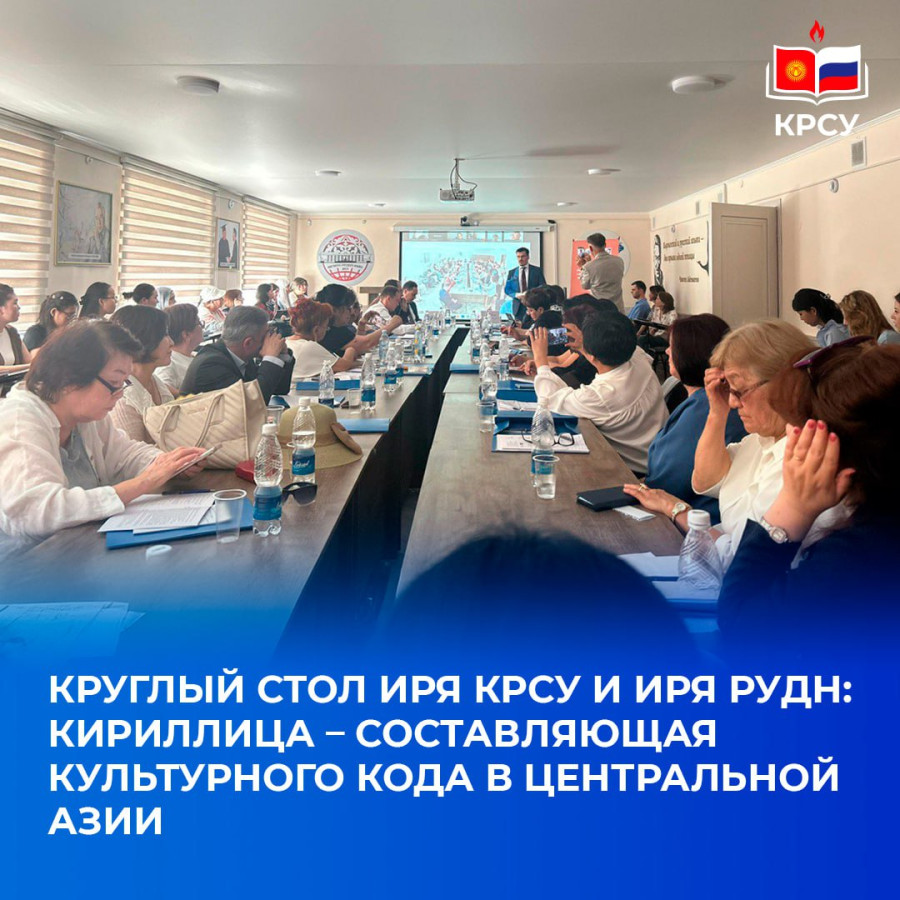
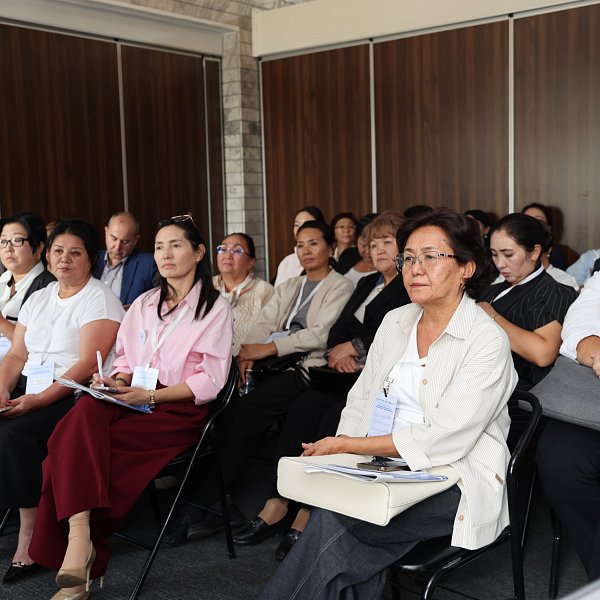
The international round table «The role of the Russian language and the Cyrillic alphabet in the formation of the cultural code of the inhabitants of Kyrgyzstan and the peoples of Central Asia» took place on May 16, 2025 at the Institute of Russian Language named after. A.O. Orusbaev Kyrgyz-Russian Slavic University named after. B.N. Yeltsin. The institute held the event in offline and online formats with the support of the Embassy of the Russian Federation in the Kyrgyz Republic, the Ministry of Science and Higher Education of the Russian Federation, the Ministry of Education and Science of the Kyrgyz Republic, with the participation of a number of specialists from the Peoples' Friendship University of Russia. P. Lumumba, National Academy of Sciences of the Kyrgyz Republic, representatives of the teaching staff, as well as students, graduate students and undergraduates of a number of CIS universities, Kyrgyz journalists, public figures and civil servants.
At the opening of the event, R.G. made greetings. Fedorov, representative of the Ministry of Education and Science of the Russian Federation at the Embassy of the Russian Federation in the Kyrgyz Republic; P.S. Gultyaev, representative of Rossotrudnichestvo in the Kyrgyz Republic; N.V. Pomortseva, Doctor of Pedagogical Sciences, Professor, acting. O. Director of the Russian Language Institute of RUDN University; K.K. Konkobaev, Doctor of Philology, Professor, Head of the Turkology Sector of the National Academy of Sciences of the Kyrgyz Republic.
On behalf of the KRSU administration, E.V. addressed the guests and participants of the round table. Shekunov, vice-rector for Scientific, International and Innovation Activities KRSU.
Opening the discussion, Director of the Institute of Russian Academy of Sciences KRSU, Doctor of Philology, Professor M.J. Tagaev emphasized: «Thanks to the Cyrillic alphabet based on two interacting languages, a cultural and linguistic environment that promotes the generation of creative individuals with a high level of human capital is preserved and successfully functions in Kyrgyzstan. The displacement of the Cyrillic alphabet, which has entered the blood and flesh of Kyrgyzstanis, its replacement with another writing system, can have irreparable consequences that will throw the country back into the abyss of backwardness, which our descendants will not forgive us for».
Talking about the history of the Kyrgyz language acquiring the Cyrillic alphabet, Professor Tagaev informed the participants that the Kyrgyz, as one of the oldest peoples of Central Asia, have changed several graphic systems – Arabic, Latin and Cyrillic in recent centuries. The Arabic alphabet was used in the second half of the 19th and early 20th centuries. and was represented only by isolated texts in the Kyrgyz language. The Latin alphabet functioned in Kyrgyzstan from 1920 to 1940 and did not take deep roots among the illiterate population at that time. Cyrillic was introduced in 1940, over 85 years this writing system has become the most important part of the mental-linguistic consciousness of the Kyrgyz, an effective way of development.
Addressing the audience, the professor convincingly called on everyone to express their opinion on the meaning of the Cyrillic alphabet in Kyrgyzstan.
The discussion, which was attended by 8 speakers and expressed the opinions of more than 70 participants and listeners, took place in the following areas: Cyrillic in the cultural and historical aspect; the role of the Russian language and the Cyrillic alphabet in Central Asia in the modern era; Cyrillic as a cultural code and a way of storing the historical memory of the peoples of Central Asia; Cyrillic as a factor in the development of bilingualism and the formation of a bilingual cultural and linguistic environment in Kyrgyzstan and the countries of Central Asia.
Among the issues discussed are – the impact of geopolitical events of the post-Soviet and current times on the status of the Russian language and the preservation of the Cyrillic alphabet, as well as possible scenarios for the development of the language situation in Kyrgyzstan and Central Asia.
Round table summary – resolution, accepted by the participants.