Higher education in the era of AI: new approaches to assessing students are being discussed in Tyumen
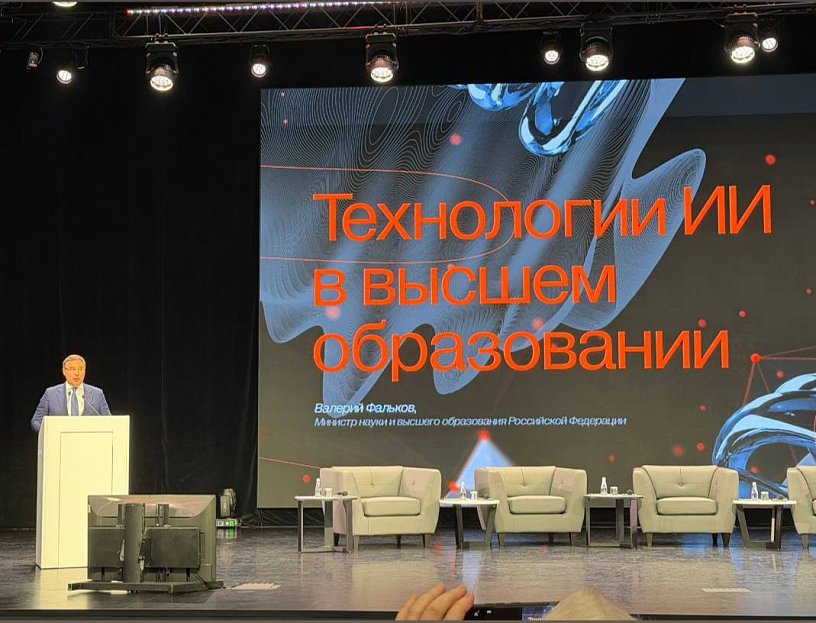
The III Forum «Artificial Intelligence Technologies in Higher Education» continues to operate at the site of Tyumen State University, bringing together university leaders, representatives of government authorities, the scientific community and the IT industry. Among the forum participants is the rector of the Kyrgyz-Russian Slavic University Sergei Volkov.One of the key topics of the forum was the introduction of artificial intelligence into the educational process. Russian Minister of Science and Higher Education Valery Falkov proposed making the study of AI technologies mandatory for all university students.«Our proposal is to give everyone a basic module already in the first year. Since the university provides a profession, and in relation to the profession, artificial intelligence technologies have their own well-known specifics - biologist, geographer, historian, lawyer, economist, engineer, we believe that there should be a professional module in every educational program. Thus, our answer is two mandatory modules that every student must study: a basic module and a professional module», the minister said.According to Valery Falkov, the content of the courses, their volume and the ratio of the two modules are still being discussed. To implement the basic course, it is planned to create an educational and methodological association that will develop the content of the discipline and a unified educational platform that will allow monitoring the results of students’ education.The minister also noted that a separate task will be to prepare teachers to work with new educational modules. Considering the rapid development of artificial intelligence technologies, the system of advanced training for teachers should become continuous.The minister also said that artificial intelligence is already changing traditional approaches to assessing students' knowledge.«A massive technology for testing knowledge, like our test and measurement materials, is writing dissertations or coursework. What happened 20-30 years ago and worked quite well has changed today in a number of study programss. Diploma papers no longer perform the function that they performed in higher education 10-15-20 years ago», he noted.According to Falkov, in the future the format for protecting final qualifying papers may change. Knowledge testing will shift from text assessment to oral response, which will allow a more objective assessment of students’ real knowledge and competencies.Tyumen State University, where the forum is taking place, is one of KRSU’s key partners in the implementation of the project «First Digital University in Central Asia». Participation in the forum allows the university to study the best practices in introducing artificial intelligence into educational, scientific and management activities.