Combat mandate
Lyubov Borisenko. Rossiyskaya Gazeta - Week - Kyrgyzstan. Only 17 of the 54 deputies of the first convocation of the Supreme Council of the Kyrgyz SSR who went to the front met the victorious May 1945. The people's representatives raised soldiers to attack near Moscow and Stalingrad, fought on the Kursk Bulge and stormed Berlin.
Jalal-abad political instructor
In the summer of 1938, the first convocation of the republican parliament - the Supreme Council - began work in Kyrgyzstan. One of those who received the mandate of the people's representative was Nurlan Bozoev. He was born and raised in Kemin, but worked in the Komsomol field in the south of the country. He was the second secretary of the Jalal-Abad District Committee of the Komsomol.
When the war began, Nurlan was not even 25. In September 1942, he went to the front as a volunteer. The young man had to fight in one of the most tense areas - the Rzhev direction. And on February 23, 1943, the newspaper "Soviet Kyrgyzstan" published an article quoting a letter from the head of the political department of one of the military units.
"In recent battles, when our formation knocked out the fascist scum from heavily fortified positions, the enemy wanted to stop our advance at all costs," the article said. - Fascist tanks rushed to the battle formations of our units, including a battery of anti-tank guns, where the deputy commander for political affairs was the deputy of the Supreme Council of the Kyrgyz SSR Nurlan Bozoev. He and his fighters entered into an unequal battle. One tank caught fire, the second and third flared up with torches... However, the Nazis continued to push. The critical moment has come. It seemed not humanly able to stop the armored vehicles that were sowing death. At that moment Bozoev’s battle cry was heard: "Kyrgyz! We will die, but we will kill the fascists, we will not let them go one step ahead!'.
Nurlan Bozoev was seriously wounded in that battle. Fellow soldiers ran up to him to carry his comrade out of the battlefield, but he said: "When we kill all the scoundrels, then you will take him to the medical unit, and now I must fight the Nazis.". The second wound turned out to be fatal for the hero. He died on December 1, 1942, a few days before the start of the Red Army's offensive.
Tank named after Bati
Another deputy of the first convocation, Vasily Kostyrya, once worked as a miner in the mines of Donbass. In 1936, he was drafted into the army, and he had to serve on the Kyrgyz-Chinese section of the Soviet border, where it was restless. Either Basmachi gangs tested the strength of the line, or smuggling detachments paved the way for their caravans with weapons.
The Central State Archive of Kyrgyzstan contains the memories of Vasily Kostyr’s colleagues about how boldly he led the border guards into saber attacks. There was a case when he, with one machine-gun crew, disrupted the crossing of a large gang of state border violators. For his courage, courage and determination, the fighters began to call him "father.".
On the eve of the Great Patriotic War, he, the commander of the maneuver group of the 14th Alai-Gulchin Border Commandant's Office, was elected as a deputy of the Supreme Council of the Kyrgyz SSR. People came to him with requests, talked for help and advice. He didn't refuse anyone. He received people with a smile and knew how to find words of support.
In early 1940, many of his comrades were transferred to the western border of the USSR. In June 1941, Vasily Kostyrya wrote a report asking to be sent to the front.
In accordance with the order of the NKVD of the USSR N 00837 dated June 29, 1941 on the formation of fifteen rifle divisions for the Red Army, the Alai-Gulchin, Tashrabat, and Przheval border commandant's offices of Kyrgyzstan sent the best border guards to staff the formations being formed. Among them was Vasily Kostyrya. The military unit where he was to continue his service was named the Yaroslavl Division at the place of formation. On July 16, 1941, it arrived at the front in the Smolensk direction.
Vasily Kostyr managed to fight for only a week, but even this period was enough for the feat. Before his last battle, he personally reconnoitered enemy positions, and then went on the attack with the battalion. At four in the morning the unit forded the river and immediately knocked the enemy out from a commanding height. The fight was brutal and merciless.
Assistant Chief of Staff of the 910th Infantry Regiment of the 243rd Motorized Division, Captain Vasily Timofeevich Kostyr was found dead in earing rye. The badge of a deputy of the Supreme Council of the Kyrgyz SSR was scarlet on a bloody tunic. Before the fight, Vasily wrote a letter to his family. "Verusya! My dear and beloved children! I write at three in the morning. I had just finished urgent work to the roar of enemy guns. Now I want to lie down, but I don’t know how you can advise me whether to rest or work?...".
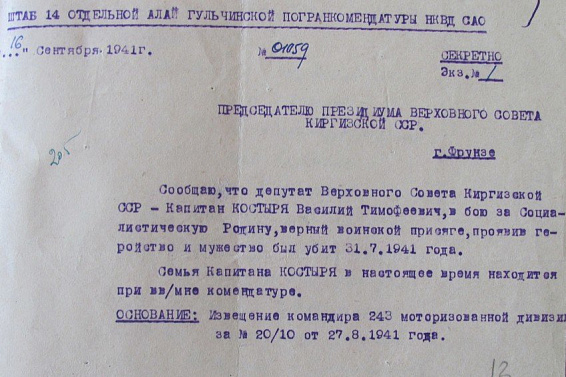
In September, the Presidium of the Supreme Council of the Kyrgyz SSR received a letter from the Alai-Gulchin border commandant’s office, which reported that "a deputy of the Supreme Council of the Kyrgyz SSR in the battles for the socialist Motherland, faithful to the military oath, showing heroism and courage, was killed on July 31, 1941.".
In November 1941, the Leninsky Put newspaper announced a fundraiser for the construction of a tank named after Vasily Kostyr, a deputy of the Supreme Council of the Kyrgyz SSR.
Osh Hungarian
Yuldash Amraev was also one of the young deputies of the first convocation of the Supreme Council of the Kyrgyz USSR. He received the badge of the people's representative at the age of 27, and a little earlier he was awarded the Order of the Badge of Honor. In 1940, Yuldash was sent to Moscow - to the higher party school. He did not have time to finish his studies. In 1941, immediately after the start of the war, he returned to Kyrgyzstan, from where he was drafted into the army.
Amraev went through the battle route from Moscow to Budapest On February 12, when the decisive battle for the capital of Hungary began, he died a brave death, raising the fighters of his unit to attack.
"Red Army officer and deputy of the Supreme Council of the Kyrgyz SSR Yuldash Amraev is buried next to his 120 fellow soldiers who died in the battles for the liberation of Hungary, in a mass grave number Z36-762 in the village of Deg (Veres Hadšorg St.) south of Székesfehérvár," the official statement says. notice received by the hero’s family.
Comment
Leonid Sumarokov, Candidate of Historical Sciences, Vice-Rector of KRSU:
"Becoming a deputy of the first convocation of the Supreme Soviet of the Kirghiz SSR was not only an honor, but also a great responsibility. They chose the worthy, those who enjoyed enormous authority and respect for their work. They were trusted and followed. In turn, what could the deputies promise their voters? Only one – give all your strength to serve the people. They kept their promise, and even more. They gave their lives for the people.
We collected information about the exploits of the people's deputies of the first convocation literally bit by bit. We even managed to contact the relatives of many of them. The result of our work was a research book «Front Roads of People's Deputies». Unique archival materials are collected here.
The fates of the deputies of the first convocation turned out differently, but I can say with confidence that they justified their title with honor. Letters of gratitude from the command of military units, memories of colleagues, and diaries have been preserved. This is a whole story and should not be forgotten.