Will the Russian language lingua franca remain in the science of post-Soviet countries?
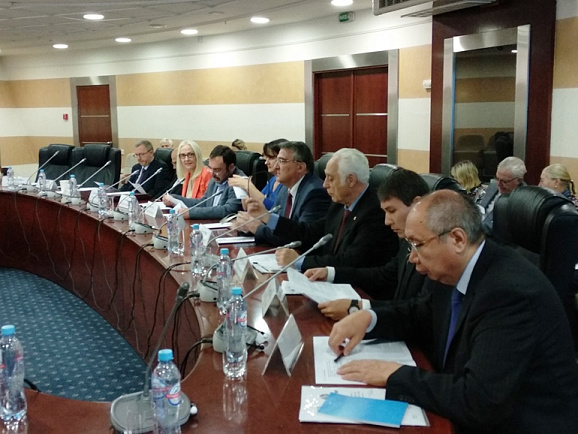
On September 25, a scientific and practical conference «Eurasian integration processes in the field of education began at the Moscow State Institute of International Relations (MGIMO) with the support of the » Russian World«Foundation. Problems and prospects of scientific publishing activities in Russian». Representatives of the university and scientific community from Armenia, Belarus, Kazakhstan, Uzbekistan, Tajikistan, Kyrgyzstan, Moldova and Estonia took part in the discussion of pressing problems of publishing scientific journals, scientific citation systems and general issues of the future of Russian-speaking scientists in other countries.
The guests were greeted by MGIMO Vice-Rector for Scientific Affairs E. M. Kozhokin. Vice-Rector for Master's and International Programs A. A. Baikov, Director of the Department of State Scientific and Scientific-Technical Policy of the Ministry of Science and Higher Education of the Russian Federation M. Yu. Romanovsky and Deputy Executive Director of the Foundation «Russian World» S. V. Shurygin.
At the first session «Scientometry and prospects from the point of view of international rankings», presentations were made by the Vice-Rector for Scientific Work of the Kyrgyz-Russian Slavic University V. M. Lelevkin («Integration processes of cooperation between KRSU and the EAEU»), Director of the Institute of International and Regional Cooperation of the Kazakh-German University B. K. Sultanov, Vice-Rector for Scientific Work of the Russian State University for the Humanities O. V. Pavlenko («World trends in the development of social, humanitarian, scientific and technological research: prospects for Russian universities»), head of the Center for Post-Soviet Studies at IMEMO RAS E. G. Solovyov («Research and publishing activities of IMEMO in Russian»), head of the editorial department publishing work of BSU N. N. Gerasimovich («Publishing activities of BSU: problems, prospects»), professor of the department of Russian language and theory of literature of Moscow State Linguistic University O. V. Yevtushenko («Eurasian integration in the educational process: from the experience of project implementation»).
During the second session «Russian-language scientific journals and their place in the international information space», speeches were made by the General Director of the scientific electronic library Elibrary.ru G. O. Eremenko («Russian Science Citation Index as an integration project in the post-Soviet space»), President of the Higher Anthropological School, editor-in-chief of the journal «Stratum plus» (Moldova) M. E. Tkachuk («Stratum plus magazine. 20 years in Russian. Experience of integration into the international scientific community»), chief editor of the journal «Bulletin of MGIMO-University M.V. Kharkevich («About MGIMO scientific journals»), editor-in-chief of the international peer-reviewed journal «Structures and functions: studies in Russian linguistics» I. Yu. Mangus («Publishing activities in Russian in Estonia»), Deputy Director for Scientific Work of the Institute of History of the National Academy of Sciences of the Republic of Armenia K. G. Khachatryan («Problems and prospects for publishing scientific, historical and educational literature in Russian in the Republic of Armenia»), editor-in-chief of the journal «Modern Europe» R. N. Lunkin («Support for the scientific community of Eurasia through Russian-language publications») advisor to the MGIMO administration L.K. Raitskaya («Multilingualism in Russian scientific journals: preservation of the Russian language as lingua franca in science and promotion of Russian science»), scientific and artistic editor of the Internet portal and electronic journal «Foreign languages in Uzbekistan» U.N. Bekmuradov («Scientific journals of Uzbekistan: problems and prospects for their development (using the example of humanitarian journals)») deputy Editor-in-Chief of the Journal «International Life» E. B. Pyadysheva («Who reads Russian scientific and political journals abroad?»).