The pioneers are surprising. Kyrgyz-Russian Slavic University – 25
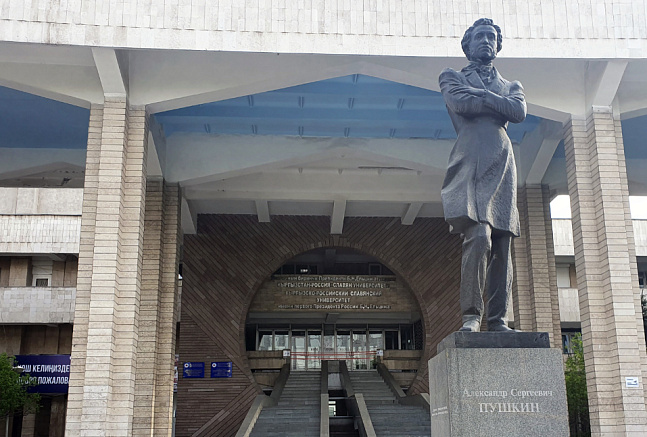
Kyrgyzstan and Russia are preparing to celebrate the 25th anniversary of their brainchild – Kyrgyz-Russian Slavic University. Created after the collapse of the great Soviet country, the university became a spiritual bridge connecting the peoples of Eurasia, bringing education, disseminating knowledge, sending impetus to the development of science. His activities perfectly reflect the state of Kyrgyz-Russian cooperation, focused on mutual assistance and work for the future.
Fruits – to the peoples of the two countries
In November 2017, an important event occurred in the life of the university – Prime Minister of Kyrgyzstan Sapar Isakov presented the university with the Order «Dostuk» (translated into Russian – «friendship»). The university was awarded this award on the basis of a decree of President A. Atambayev on the occasion of the 25th anniversary of the independence of the Kyrgyz Republic for its special contribution to the development of the socio-economic, spiritual and intellectual potential of the country.
Presenting a high state award, the Prime Minister noted the great role of the university in strengthening bilateral relations between Kyrgyzstan and Russia. «I believe, – said S. Isakov, – that the timely creation of this university served as a powerful bridge of friendship between our peoples, between our countries. This decision was very correct».
The mission that was prepared for the university by the agreement signed on September 9, 1993 between the governments of the two countries turned out to be very responsible – to organize educational, scientific, educational activities under the state flags of Russia and Kyrgyzstan. In the post-Soviet period, the university became a pioneer in preserving and strengthening the position of the Russian educational system in Central Asia. Over the course of a quarter of a century, it has turned into a classical educational institution that trains specialists for various fields of activity. University graduates work in medicine, mining and mechanical engineering, defend the law, protect people's rights, contribute to culture, manage interstate relations, and strengthen the position of the Russian language in the Central Asian region.
WITH. Isakov noted at the award ceremony that among the graduates of KRSU – there are many successful entrepreneurs and government officials who contribute to the development of the country’s economy. «There are guys who are working to strengthen our friendly relations, – stated the head of the Kyrgyz government. –It is happiness when a university gives such fruits to the peoples of the two countries».
Responding to the global formation of an innovative society
In 1997, the university graduated its first students. Then 138 specialists left the university, having undergone training in eight areas specific to that period of time – economics, management, law, computer science, meteorology, as well as philology and physics. The qualification suitability of young specialists was confirmed by diplomas from the Russian Federation and the Kyrgyz Republic.
Since then, the total number of graduates has increased many times, reaching 27 thousand people on the eve of the 25th anniversary (the university trains in 39 areas of bachelor's degree, 8 areas of master's degree, 6 specialties). Among the new areas are – clinical medicine, electronics, radio engineering and communication systems, applied geology, mining, oil and gas engineering and geodesy. It is obvious that the priority tasks for the university have become the training of highly qualified specialists capable of developing and implementing creation projects, which is so important not only for Russia and Kyrgyzstan, but also for the entire Eurasian space.
A high level of training is achieved through the active involvement of students in scientific activities. According to statistics, 27% of students participate in it. The university is trying to keep up with the times, responding to the trend of global formation of an innovative society.
At the mining enterprises of Russia, Kazakhstan, Uzbekistan, and Kyrgyzstan, the Blast Maker software and hardware complex (PTK) created by university scientists, which is an automatic design system for drilling and blasting operations in quarries, operates effectively. In Russia, Kazakhstan, Tajikistan, and Turkey, a university project in the field of «hydropulse energy» related to the technical re-equipment of water use facilities has been introduced. Another achievement – introduction of a set of methods for instrumental monitoring of the stability of a hydroelectric dam under seismic influences.
And this is not a final list of scientific developments implemented in industrial production, medicine and providing economic effects. An important indicator of the university’s scientific activity is – three gold medals of the World Intellectual Property Organization, recently received by KRSU scientists.
Goal – integration!
The university offers specific programs aimed at integration into a single educational space of the EAEU countries and focused on solving socially significant problems of the region. Among the main points of concentration of efforts, the university highlights: the Russian language in Central Asia; sustainable economic development; small energy and hydropower; modern technologies in education and science; mountain habitat and human life in it; protection of the gene pool, reproduction and human health; regional climate and water use; intercultural and interreligious dialogue.
In the summer of 2016, the university carried out an unprecedented campaign – carried out a medical examination of residents of the high-mountainous Susamyr Valley. In two regions of Kyrgyzstan, Zhaiyl and Talas, two patient reception points were created. Each of them employed a therapist, a pediatrician, an obstetrician-gynecologist and a surgeon, an ultrasound room, a laboratory, and a treatment room. Four doctors of science entered the medical landing. And most importantly – students who have received perhaps the most important lesson for themselves – a lesson in attention and care. As a result, 961 patients were admitted, examined and examined by university doctors. In some cases, identified patients were provided with medical care on the spot and provided with free medicines, while others were given referrals to medical institutions of the republic based on their disease profile.
An example worthy of role is also the practice of strengthening the spiritual unity of the peoples of the post-Soviet space, which is the basis of integration processes. The university offers here its own experience in preserving historical memory, striving to present the scientific community and the public of the region with an objective view of historical events, which in modern conditions are increasingly being addressed by public eyes. In the process of scientific research, university scientists set themselves the task of not just presenting an objective picture of the past, but indicating directions for further development based on the lessons of the past. An important scientific work in this regard was the documentary collection «Great October of Kyrgyzstan» dedicated to the 100th anniversary of the October Revolution of 1917 and the 25th anniversary of the establishment of diplomatic relations between the Russian Federation and the Kyrgyz Republic.
Responding to the 100-year-old tragedy that occurred in Turkestan in 1916, the university prepared and published a six-volume collection of documents «Central Asian (Turkestan) Uprising of 1916. History in documents». The basis of the publication was images – exact copies – of more than 300 documents identified in the archives. This kind of publication was published for the first time in the post-Soviet space. Thus, a unique documentary base has been created that will allow scientists, as well as everyone interested in the problem, to look at the history of the 1916 uprising and subsequent events with an open mind and as objectively as possible.
Of no less interest are developments on the history of the Great Patriotic War. Working on the topic, on the one hand, is an opportunity to improve educational work with young people, involving them in scientific research and at the same time giving them the opportunity to feel proud of their great ancestors who defeated fascism, and on the other hand, to repel attempts to falsify the results of the Second World War. Among the fundamental works published over the past two years and which have become teaching aids for young people, we will name only two historical and documentary collections – «Unity that defeated fascism» and «Stalingrad Diary of Kyrgyzstan».
The idea of maintaining unity in the Eurasian space is dominant in the activities of the KRSU. Its implementation is carried out thanks to increased efforts to preserve the position of the Russian language. The university, using various well-known forms for this, offers new ones. For example, the university event «Russian Language Office for Schools» is indicative. Its essence is that the university will equip, free of charge, visually and technically, classrooms for Russian language and literature in schools in Kyrgyzstan. The first such office opened in the village of Ken-Bulun in 2014. The university scientists based its creation on the thesis: «With the Russian language I will discover the world». The project was a success – Ken-Bulun secondary school became a methodological center for Russian language teachers in the Issyk-Ata district of the Chui region.
* * *
The creation of the Kyrgyz-Russian Slavic University was a truly significant event – our countries were the first in the post-Soviet space to demonstrate a desire to preserve and strengthen a unified educational space. The first experience gave impetus to the creation of similar universities in Tajikistan, Armenia, Belarus, Moldova, and Azerbaijan. This means that the spiritual unity of the peoples of post-Soviet countries continues to live. Respect to the pioneers!
Link to the original source -->>