«Dialogue of cultures in the media space»
Dear colleagues!
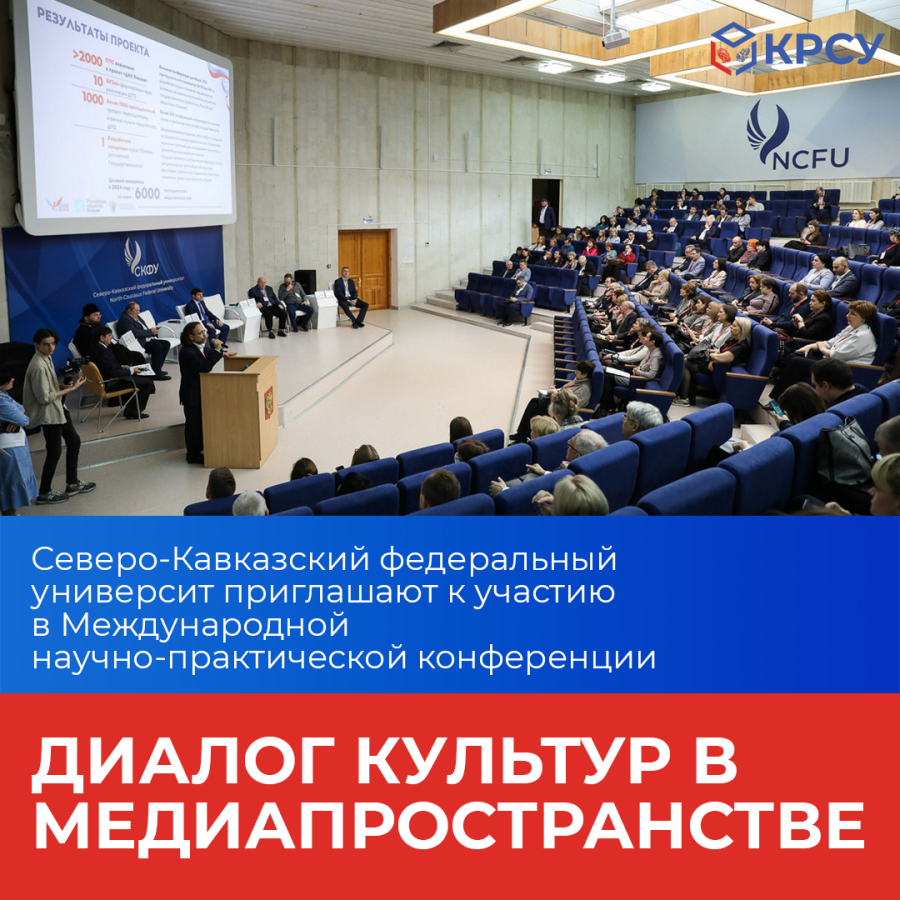
The Department of Journalism and the basic department of television and radio journalism of the North Caucasus Federal University invite you to participate in the International Scientific and Practical Conference «Dialogue of cultures in the media space», dedicated to the 30th anniversary of journalistic education at NCFU.
The conference organizers proceed from an understanding of the diversity of cultural definitions and its elements (including symbols, heroes, values, etc.), forms (mass, folk, elite, ethnic, subcultures, etc.), types (visual culture, etc.), cultural practices.
The following issues were brought up for discussion:
- Being and/or dialogue of different forms of cultures in pre-revolutionary journalism.
- Broadcast of another culture in the media environment.
- The existence and/or dialogue of different forms of cultures in modern media.
- Modern experience of convergence of cultural codes.
- Neural network / artificial intelligence and cultural practices in media.
- Cancellation culture and its reflection in the media.
- The role of radio and television in the broadcasting of cultural practices.
- Mass culture in the system of mass communication.
Teaching staff of Russian and foreign universities, employees of research institutes, graduate students, and practicing journalists are invited to participate.
Date of the event 4-5 October 2024: October 4 at the North Caucasus Federal University, October 5 – visiting expert session at the Caucasian Mineral Waters (at the request of the participants; the cost will be announced additionally).
Based on the results of the international conference, a collection of materials will be published pdf-the compilation version has been sent to the authors. The collection materials will be posted in the RSCI.
To participate in the conference you must
until August 20, 2024
zfill out the participant's application and attach abstracts of the report https://forms.yandex.ru/u/667c056b3e9d080f6d4388a1/
The organizers reserve the right to reject applications that do not correspond to the topic.
Requirements for the design of materials
-
- Text of the report (volume 2000 – 4000 characters with spaces) without a title complex and reference list.
- Originality of copyright material in the system «Anti-plagiarism» – not lower 75 %. The generated text is not accepted.
- Text is typed in Times New Roman font, font size – 14, line spacing – 1.0 (single), margins (all) – 2 cm, indentation – 1.25 cm. Automatic carryovers are not allowed. Pages are not numbered.
- The title is written in upper case, bold, center aligned.
- This is followed by the surnames and initials of the author/s (italics), below – full name of the university or organization (without indicating the organizational and legal form), on the line below – city, country in brackets, below e-mail, alignment to the center.
- Abstract in Russian – 150– 250 characters with spaces.
- Keywords – 5–7 words.
- The text of the report is reflected in an empty line from keywords and the list of references.
- References to the sources used are given after the quote in square brackets, indicating the serial number of the citation source in the reference list and the page, for example [1, p. 25].
- The list of references is compiled from sources cited in the material it is located after the text, preceded by the word «List of references», numbered (starting from the first issue) and drawn up in order of citation in the text (not in alphabetical order!). Literature is drawn up in accordance with GOST 7.0.5–2008. Numbering is not automatic.
- The abstract file of the report is entitled with the author's last name and the word «abstracts» (example: Gorbachev_Abstracts).
Example of design
SIMULATOR AS A FORM OF STUDENT TRAINING
TO WORK IN MULTIMEDIA JOURNALISM
Gorbachev A.M.
North Caucasus Federal University
Stavropol, Russia)
agorbacgev@ncfu.en
Abstract. The article discusses the design and possibility of using the simulator in training a future Internet editorial specialist. Examples of simulators, options and technology for development in conditions of a limited budget are presented, and an opinion is expressed about the prospects of developing an online simulator for mastering journalistic skills.
Keywords: simulator, online simulator, innovative teaching methods, multimedia journalism, journalist training.
Text, text, text, text, text, text, text, text, text, text, text [1, p. 14]. Text, text, text, text, text, text, text, text, text, -, text, text, text, text, text, text, text, text, text, text, text, text, text, text, text, text, text, text, text, textext, text, text, text, text, text, text, text, text, text, text, text, text, text, text, text, 14].
List of references
1. Goeva V.V., Mironov K.E. The use of active and interactive teaching methods when studying technical disciplines in universities //Karelian Scientific Journal. – 2016. – № 2 (15). <TAG1> P. 11–15.
2. Tikhonova O.V., Podzolkova I.Yu. TV channel «World of Belogorye»: features of functioning //Mediascope. – 2022. – Vol. 1. – URL: http://www.mediascope.ru/2770
Chairman of the Program Committee – Head of the Basic Department of Television and Radio Journalism of NCFU, Professor Lepilkina O.I. oll5@mail.ru
Chairman of the organizing committee – Head of the Department of Journalism of NCFU, Associate Professor Gorbachev A.M.

.jpg)
.jpg)